8 tips for mastering retail customer service
What does it take to create excellent customer service in retail? Learn all about the biggest challenges and how to overcome them in our guide.



Mozhdeh Rastegar-Panah
Senior Director, Product Marketing
Last updated March 19, 2026
What is retail customer service?
Retail customer service is the end-to-end support retailers provide before, during, and after a purchase. It refers to helping customers discover products, answering questions about availability or pricing, resolving returns or delivery issues, and managing warranties or exchanges. Modern retail customer service spans across omnichannel ticketing system touchpoints, including email, live chat, social media, SMS, self-service portals, and AI agents. Successful retailers combine human support and AI-powered automation to deliver fast, personalized, and consistent service across online and in-store experiences.
A guide to customer service for retail
Customers expect fast, consistent answers without repeating themselves, even as retailers manage complex fulfillment and constantly changing inventory. As a result, modern retail customer service now spans every step of the customer journey, across all channels. Support ranging from product and delivery questions to post-purchase assistance can now be delivered via chat, email, social media, and SMS.
This guide breaks down what retail customer service is, why it matters, the biggest challenges retailers face, and eight practical tips to improve CX. You’ll also learn the key skills teams need to deliver faster resolutions and more personalized support at scale.
More in this guide:
- The importance of customer service in retail
- The biggest challenges in retail customer service
- 8 essential retail customer service tips
- 5 necessary skills to improve retail customer service
- Frequently asked questions
- Boost your retail customer service with Zendesk
The importance of customer service in retail
Retail customer service is a defining factor in retail success. In the past, 5-star service was the exception rather than the standard. Today, the growth of ecommerce and the saturation of the retail market have made it easier for customers to switch brands. When they experience bad customer service, customers are highly likely to abandon a retailer instantly, even after years of loyalty.
As a result, customer experience in retail, especially across digital and omnichannel environments, has become a key competitive differentiator. Retailers that deliver fast, seamless, and personalized support are the ones that build loyal relationships, protect revenue, and stay ahead.
The biggest challenges in retail customer service
The biggest challenge in retail customer service is delivering consistent, personal support at speed, even when data is spread across multiple systems. Customers move between online and in-store experiences, expect instant answers, and don't want to repeat themselves across channels. This often leads to service teams juggling higher request volumes, more complex fulfillment models, and constant changes to products and promotions.
To keep up, retailers need connected tools, accurate information, and workflows that adapt in real time. Here's a break down of the biggest challenges in retail customer service:
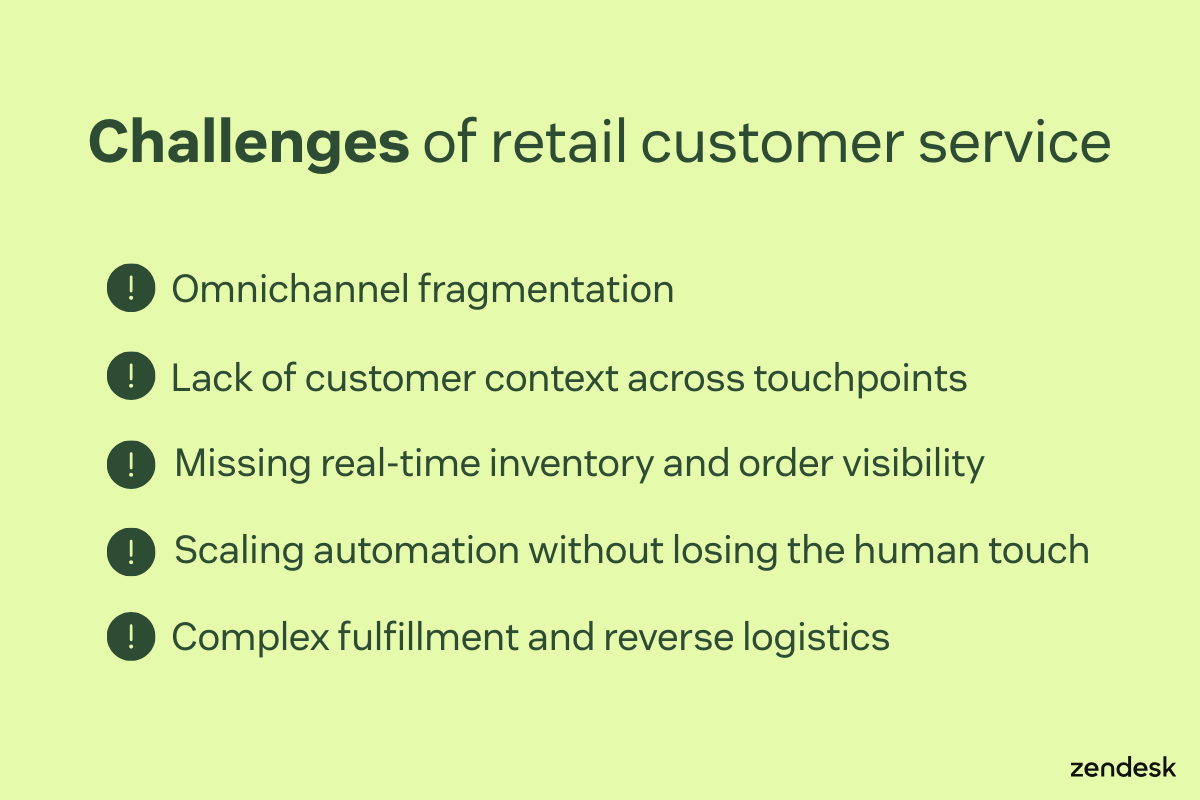
- Omnichannel fragmentation: Conversations happen in isolation across email, chat, social, phone, and in-store, creating inconsistent experiences and duplicated effort.
- Lack of customer context across touchpoints: When agents can’t access the full history of past orders, preferences, or prior issues, they ask the same questions customers answered before, leading to slower resolutions and frustration.
- Missing real-time inventory and order visibility: Without up-to-date stock and shipment data, teams can’t set clear expectations, proactively communicate delays, or resolve order location inquiries quickly.
- Scaling automation without losing the human touch: Automation can reduce volume, but poorly designed bots and rigid flows frustrate customers when issues are nuanced or emotional. There has to be a balance between automating repetitive tasks and knowing when it's time for human assistance to intervene.
- Complex fulfillment and reverse logistics: BOPIS, ship-from-store, split shipments, returns, and exchanges introduce more failure points, raising the chances for confusion or problems.
8 essential retail customer service tips
With rising customer expectations and an ever-changing business landscape, it's not always easy for retailers to provide the level of service they'd like. Here are some best practices you can use to improve your service in every interaction.
Unify customer data across all channels
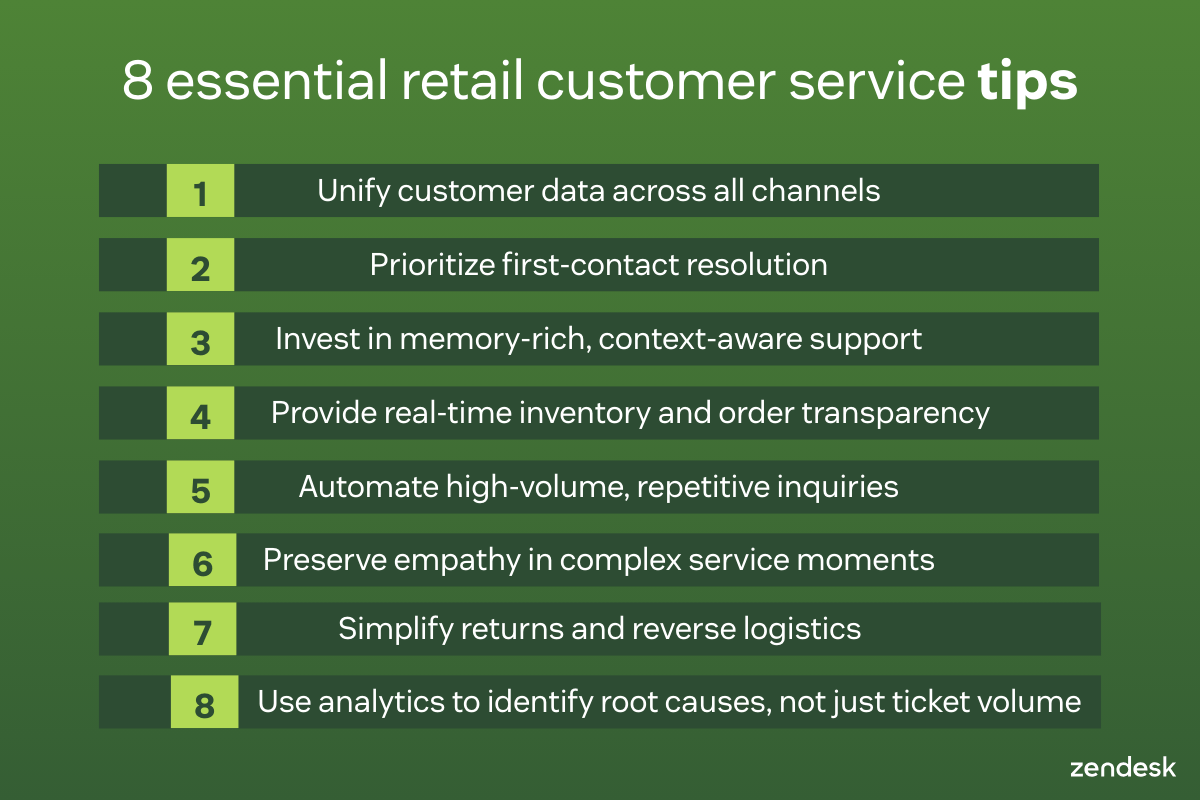
To eliminate omnichannel fragmentation, connect ecommerce, in-store, mobile, social, and contact center systems into a single customer view using customer service software. When agents and AI tools can access order history, prior conversations, loyalty status, and preferences in one place, service becomes faster, more accurate, and more personalized.
Prioritize first-contact resolution
Customers expect their issues to be resolved the first time they reach out. Equip teams with the tools, knowledge, and real-time data needed to solve problems immediately, especially for common retail inquiries like order status, returns, and delivery updates. Reducing repeat contacts lowers costs and improves customer satisfaction.
Invest in memory-rich, context-aware support
Retail customer service improves dramatically when support teams and AI agents remember previous interactions. Context-aware service prevents customers from repeating information and ensures continuity across online and in-store touchpoints, building trust and loyalty.
Provide real-time inventory and order transparency
One of the biggest retail pain points is limited visibility into inventory and fulfillment. Integrate customer service tools with order management and inventory systems to allow agents and AI to deliver accurate answers about product, shipping, and returns without delays or guesswork.
Automate high-volume, repetitive inquiries
Use AI agents and self-service tools to handle routine queries such as “Where is my order?” (WISMO), return policies, store hours, and account updates. Automating these interactions reduces agent workload, lowers cost-to-serve, and frees teams to focus on complex or revenue-driving conversations.
Preserve empathy in complex service moments
While automation is critical, high-value interactions, such as warranty claims, damaged deliveries, or VIP customer concerns, require human empathy and expertise. Design workflows that intelligently escalate complex issues to skilled agents while maintaining full customer context.
Simplify returns and reverse logistics
Returns and exchanges are a major source of customer frustration and operational complexity. Streamline reverse logistics with clear policies, proactive communication, automated return labels, and integrated workflows that connect stores, warehouses, and service teams.
Use analytics to identify root causes, not just ticket volume
Retail customer service metrics should go beyond response times and ticket counts. Leverage analytics to uncover why customers are contacting support, whether due to inventory gaps, product defects, shipping delays, or unclear policies. Addressing root causes upstream improves customer experience and reduces future service demand.
5 necessary skills to improve retail customer service
Support teams need to develop a wealth of skills to provide an outstanding CX in every interaction. Here are five of the most necessary skills to improve retail customer service.
Omnichannel communication skills
Retail customer service teams must communicate clearly and consistently across chat, email, phone, social media, and in-store interactions. Strong omnichannel communication ensures customers receive the same level of service no matter where they engage. Focus on learning how to adapt tone and messaging for each channel while maintaining brand consistency and preserving full customer context across touchpoints.
Digital and AI fluency
Modern retail service requires expertise in AI agents, automation tools, knowledge bases, and CRM systems. Employees should understand how to work alongside AI, not compete with it. This includes reviewing AI-generated suggestions, escalating complex issues appropriately, and using customer data to personalize responses. Retailers that build digital fluency into their teams are better equipped to scale automation without sacrificing quality.
Problem-solving and first-contact resolution expertise
Customers expect fast, accurate solutions. Improving first-contact resolution rates makes customers happier and fosters loyalty. Strong problem-solving skills help agents diagnose issues related to order tracking, returns, warranties, and delivery delays quickly and confidently. This requires both product knowledge and the ability to access real-time inventory and fulfillment data to resolve issues end-to-end.
Empathy and emotional intelligence
Even in an AI-driven retail environment, empathy remains a critical customer service skill. Associates must recognize customer frustration, especially during high-stakes moments such as damaged deliveries, delayed shipments, or billing disputes. Emotional intelligence allows agents to balance efficiency with understanding, strengthening trust and customer loyalty.
Data literacy and analytical thinking
Retail customer service professionals should be able to interpret performance metrics and customer insights. Understanding trends in contact drivers, return rates, and customer satisfaction enables teams to identify root causes and improve processes proactively. Data-driven service teams not only respond to problems but help prevent them.
Frequently asked questions

Dunlop Sports elevates its game with omnichannel CX
“We have dramatically improved the level of service we’ve been able to provide both internal and external customers, which wouldn’t have been possible without Zendesk functionality and reporting.”
Michael Mullen
Vice President of Operations
Read customer story
Boost your retail customer service with Zendesk
The retail space continues to grow, and businesses that want to stand out in the marketplace need to invest in retail customer service. Zendesk is a reliable customer service partner with advanced capabilities like AI agents, AI Copilot, native WFM and QA, and more that can help you deliver outstanding service in every interaction. Check out Zendesk customer service software to see how you can create meaningful connections with your customers, scale your service offering, and stay flexible through change.
Mozhdeh Rastegar-Panah
Senior Director, Product Marketing
Mozhdeh Rastegar-Panah is a seasoned customer experience leader and the Senior Director of Product Marketing at Zendesk. With over 12 years at the forefront of customer service innovation, Mozhdeh specializes in translating complex AI and CX technologies into impactful, scalable solutions for global businesses. Her work focuses on elevating customer support through messaging, automation, and omnichannel strategies. She brings a unique blend of strategic vision and hands-on expertise to the future of customer service.
Some related blog posts:

What is customer service? Key skills & examples
Customer service is the support you offer customers throughout a business relationship. Learn why it’s important and assess your own customer service aptitude.

11 ways to deliver good customer service
Good customer service is critical for retaining and acquiring customers. Learn how to meet and exceed customer expectations in our guide.

12 tips for maximizing your ecommerce customer service
From live chat to help desks to strategies for scaling, here are 12 ways to help deliver sensational ecommerce customer service. Zendesk customer Pickaweb explains the benefits of using integrated customer service software.
One face of the brand customer support
Streamlining and improving the customer service experience has been proven to increase profits for retailers.1 Simply…