Learn about the top 10 change management models and methodologies to help your team successfully navigate organizational shifts.
Justine Caroll
Director, Product Marketing
Last updated January 13, 2026
What are change management models?
A change management model is a structured framework that helps organizations plan, implement, and sustain change. It guides teams through operational shifts, like new tools or workflows, and the human side of adoption. These models help organizations drive consistent outcomes and scale change more effectively.
When change strategies fail, it’s rarely because change wasn’t necessary. They fail because people, processes, and tools don’t stay aligned. Teams feel the strain as priorities shift, systems evolve, and expectations keep rising.
Today, change is constant. Organizations are rolling out new tools, adopting AI, and reworking workflows faster than ever. But without a clear approach, these efforts create more complexity, not better outcomes.
That’s where change management models take center stage. These frameworks provide structure, helping teams navigate both operational change and human adoption. By combining proven methods with modern approaches, organizations can drive consistent, scalable transformation.
Choosing the right change management model starts with understanding your options. Each framework offers a different approach to planning, implementing, and sustaining change. The models below help organizations navigate complexity and drive consistent outcomes.
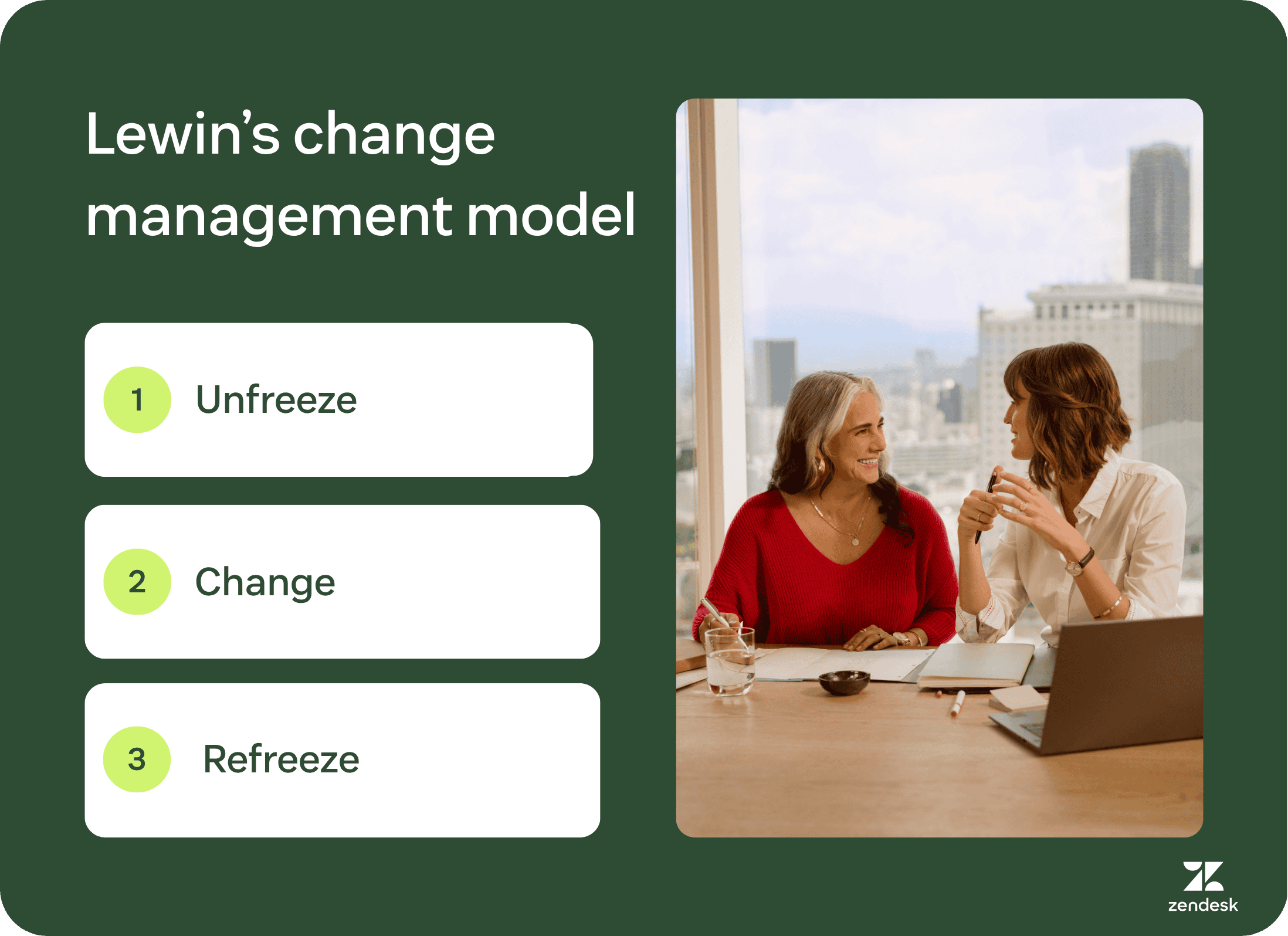
Unfreeze: This is the preparation stage. The key is to analyze how things currently work in order to identify the changes needed to reach the end result. During this stage, it’s important to communicate change management with employees so they know what to expect and how to prepare.
Change: This is the implementation phase. Put the change into practice and continually support all employees involved.
Which type of business would benefit the most from this model?
Small to midsize businesses undergoing significant organizational restructuring would benefit most from Lewin’s model. It provides a clear framework for managing change and addressing resistance effectively.
2. McKinsey 7-S framework
Developed by McKinsey & Company consultants, the McKinsey 7-S model involves breaking a change program into seven components:
Strategy: What a company wants to achieve and how it plans to do it.
Structure: How a company is organized, including who reports to whom and how tasks are divided among employees.
Systems: The formal processes and tools a company uses to get things done, like technology systems, performance evaluation processes, and budgeting procedures.
Shared values: The core beliefs and principles that guide behavior and decision-making in a company.
Skills: Employees’ abilities and expertise.
Style: The leadership and management approach within a company, including the leadership style of top executives and the overall company culture.
Staff: The company workforce, including the number of employees, their roles, and their distribution across different functions.
Breaking organizational change down into these core components helps prevent overlooking any important factors.
Which type of business would benefit the most from this model?
Large organizations undergoing strategic transformations or mergers would benefit most from the McKinsey 7-S framework. It helps leaders assess and realign various organizational components to support desired changes.
3. Kotter’s 8 steps for leading change
Harvard professor and change management expert John Kotter, created the 8-step process for leading change. Kotter’s theory focuses primarily on the people involved in a change process and their psychology. He divides it into eight steps:
Create a sense of urgency to motivate people.
Build your change team with leaders and agents of various skills and departments.
Define your strategic vision for what you want to accomplish.
Communicate with everyone involved in the change management process to get them on board and ensure they know their role.
Identify roadblocks and address anything causing friction.
Keep up the momentum throughout the process of implementation.
Maintain the changes after the initial project is complete.
Which type of business would benefit the most from this model?
Businesses of any size embarking on significant change initiatives, such as digital transformations or cultural overhauls, would benefit from Kotter’s 8-step change model. It offers a comprehensive roadmap for navigating complex change processes.
4. ADKAR change management model
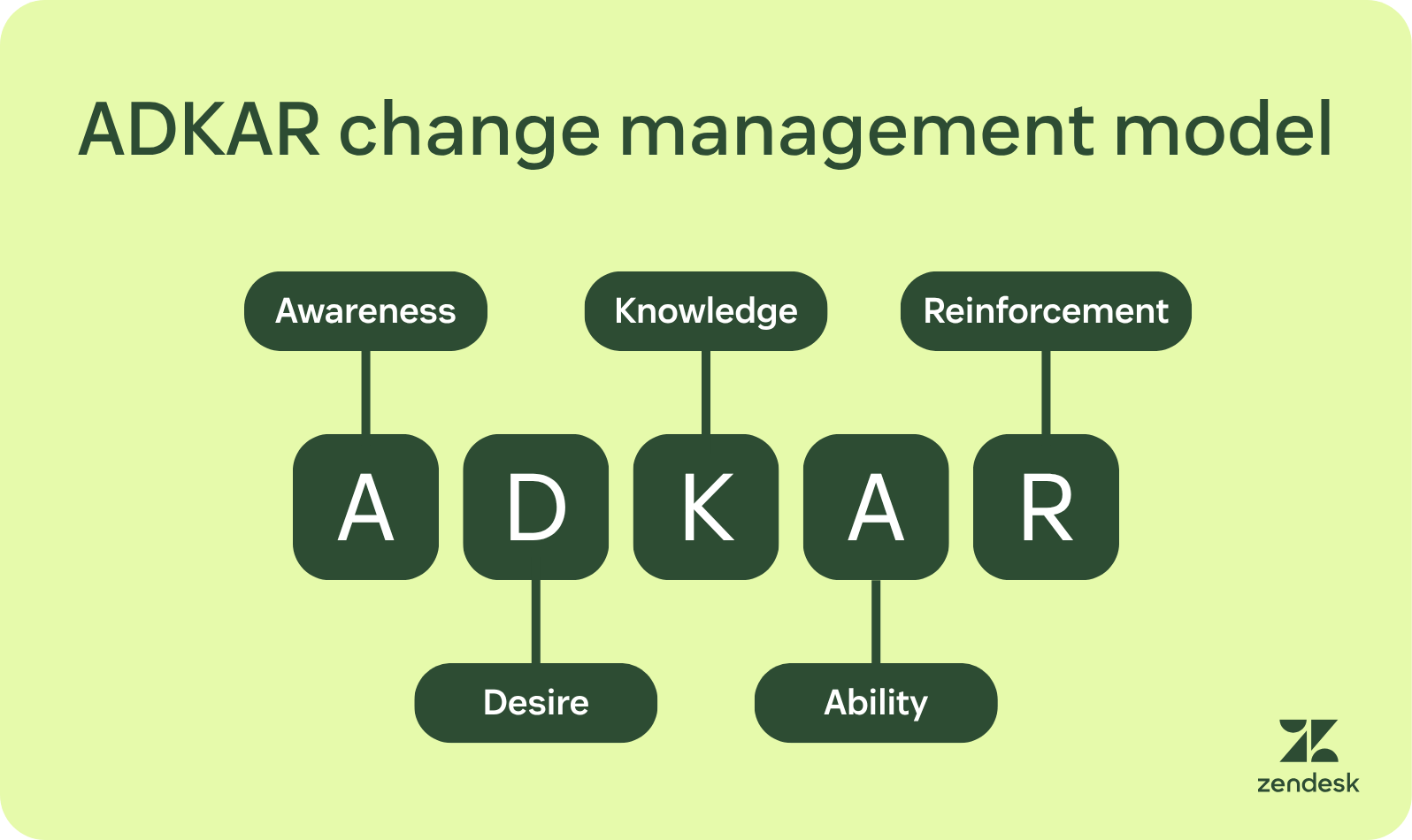
The ADKAR model, developed by Prosci founder Jeff Hiatt, identifies five main goals that a change management process should be based on.
Awareness: Ensure everyone in your organization understands the need for change.
Desire: Make your case so that everyone involved wants the change.
Knowledge: Provide the information each person needs to accomplish their part of the change process.
Ability: Make sure all employees have the skills and training they need to successfully do their part.
Reinforcement: Continue to work with employees and stakeholders after you accomplish a change to ensure commitment and consistency.
Which type of business would benefit the most from this model?
Businesses undergoing technology implementations or process changes would benefit from the ADKAR model. It helps leaders identify and address individual barriers restricting change, ensuring successful adoption.
5. Nudge theory
Nudge theory is a change management model that focuses on employing a particular mindset to encourage change rather than a step-by-step guide. Instead of issuing top-down change requests from senior executives and expecting people to fall in line, the nudge theory is about finding a persuasive way to nudge your employees toward wanting the change on their own.
Which type of business would benefit the most from this model?
Any business seeking to promote behavioral changes among employees or customers would benefit from applying the nudge theory. It’s particularly useful in areas like health and safety initiatives or sustainability programs.
6. Bridges transition model
Created by the change consultant William Bridges, the Bridges transition model emphasizes the emotional transition people go through in the course of experiencing and accepting a change. The model recognizes three stages companies should help guide employees through:
Ending, losing, and letting go: For many people, the first reaction to change is a resistance marked by fear and discomfort.
The neutral zone: When the change is starting to take place, people will be stuck between letting go of the old status quo and welcoming the new.
The new beginning: Once the new change is in place, and it’s handled well, people will enter the stage of acceptance and comfort with the new way of doing things.
Which type of business would benefit the most from this model?
Businesses undergoing leadership transitions, mergers, or significant restructuring would benefit from the Bridges model. It helps leaders understand and support employees through the emotional journey of change.
7. Kübler-Ross change curve
The Kübler-Ross change curve, also known as the five stages of grief, was created by Elisabeth Kübler-Ross and is the model used to describe the experience and process of dealing with loss. You can apply it to many experiences of change, so understanding these stages can help you better address employees’ responses to an organizational shift.
Denial: Refusal to believe the situation is a common knee-jerk response to information a person doesn’t want to hear.
Anger: When an unwanted change feels forced on a person, anger is natural.
Bargaining: People may try to push for a compromise to avoid having to accept the change entirely.
Depression: If employees are upset about the change and feel hopeless about it, they may enter a stage of depression.
Acceptance: When people realize there’s no other option, they eventually reach the point of acceptance.
Ideally, you want to design your change approach to address these potential feelings head-on and keep employees from experiencing the worst of them.
Which type of business would benefit the most from this model?
Businesses implementing major organizational changes or downsizing initiatives would benefit from the Kübler-Ross model. It helps leaders anticipate and manage employees’ emotional reactions to change, fostering acceptance and resilience.
8. Satir change model
Created by therapist Virginia Satir, this model is based on trends she saw in how families experience change. But, as with the Kübler-Ross, it can also apply to businesses. Here’s how the Satir change model is broken down:
Late status quo: The position you’re in when you first start.
Resistance: The natural response many people have when you first introduce change.
Chaos: This occurs when the change first gets implemented, and there’s still confusion and resistance from employees.
Integration: When productivity begins to level out, suggesting general acceptance.
New status quo: When employees settle into the new normal.
Which type of business would benefit the most from this model?
Businesses undergoing cultural transformations or leadership changes would benefit from the Satir model. It provides a framework for fostering collaboration, resilience, and innovation throughout the change process.
9. Resistance to change model
Rick Maurer’s resistance to change model focuses on the factors that lead to change failure. It emphasizes that poor leadership and implementation strategies are the primary reason for change failures, not resistance. The model identifies three levels of resistance:
Level 1—“I don’t get it”: This level involves rational objections due to lack of information, disagreement with data, or confusion. Leaders often mistakenly address all resistance as Level 1, focusing on providing more information when other approaches are needed.
Level 2—“I don’t like it”: This level is emotional resistance based on fear of loss, such as face, status, or control. It’s typically deep-seated and can trigger fight-or-flight responses, hindering communication and decision-making.
Level 3—“I don’t like you”: This level is based on resistance towards the leader or the organization, often due to mistrust or past negative experiences. Lack of attention to this level can lead to entrenched resistance, even if people understand and support the proposed change.
To address resistance effectively, Maurer suggests:
Making a compelling case for change by explaining why it’s necessary.
Tailoring communication to the audience’s preferences and understanding.
Emphasizing the benefits of the change and engaging employees in the process.
Building trust by being honest, keeping commitments, and investing in relationships.
Being open to feedback and willing to reconsider decisions.
By understanding and addressing resistance at all three levels, leaders can increase the likelihood of successful change initiatives.
Which type of business would benefit the most from this model?
Any business undergoing significant change initiatives would benefit from understanding and managing resistance effectively. The resistance to change model helps leaders identify potential barriers and develop strategies to overcome them.
10. PDCA cycle
The PDCA (plan-do-check-act) cycle is a widely used method in change management for implementing continuous improvement and driving organizational change effectively. W. Edwards Deming developed the PDCA cycle, also known as the Deming Cycle or the Deming Wheel.
Here’s a breakdown of each phase of the PDCA cycle in the context of change management:
Plan: Businesses assess the need for change and establish clear objectives and goals. They develop a detailed change management plan, outlining strategies, resources, and timelines while also securing support from stakeholders to ensure alignment and commitment to the proposed changes.
Do: Businesses implement their change management plan, execute activities, communicate with stakeholders, and support employees with necessary training. Progress is closely monitored to ensure adherence to timelines, and regular communication addresses any concerns or questions stakeholders may have.
Check: Businesses evaluate the progress and impact of the change initiative by monitoring key performance indicators and analyzing deviations from the planned outcomes to understand their causes. This phase offers valuable insights into the effectiveness of change management strategies and identifies areas for improvement.
Act: Businesses take corrective actions based on findings from the check phase, adjusting the change management plan and integrating successful changes into standard procedures. This phase ensures continuous improvement by addressing issues and updating strategies based on lessons learned.
The PDCA cycle is a loop. After the Act phase, start again with the Plan phase to keep improving or tackle new problems. This cycle helps organizations stay flexible and make their change management better as things change.
Which type of business would benefit the most from this model?
Businesses committed to continuous improvement and quality management would benefit from the PDCA cycle. It provides a systematic approach to identifying, implementing, and evaluating changes to enhance organizational performance.
How to choose the right change management models for your organization
Choosing the right change management model isn’t always straightforward. Different organizations face different challenges, from scaling operations to adopting new technologies. The right approach depends on your goals, complexity, and how your teams adapt to change.
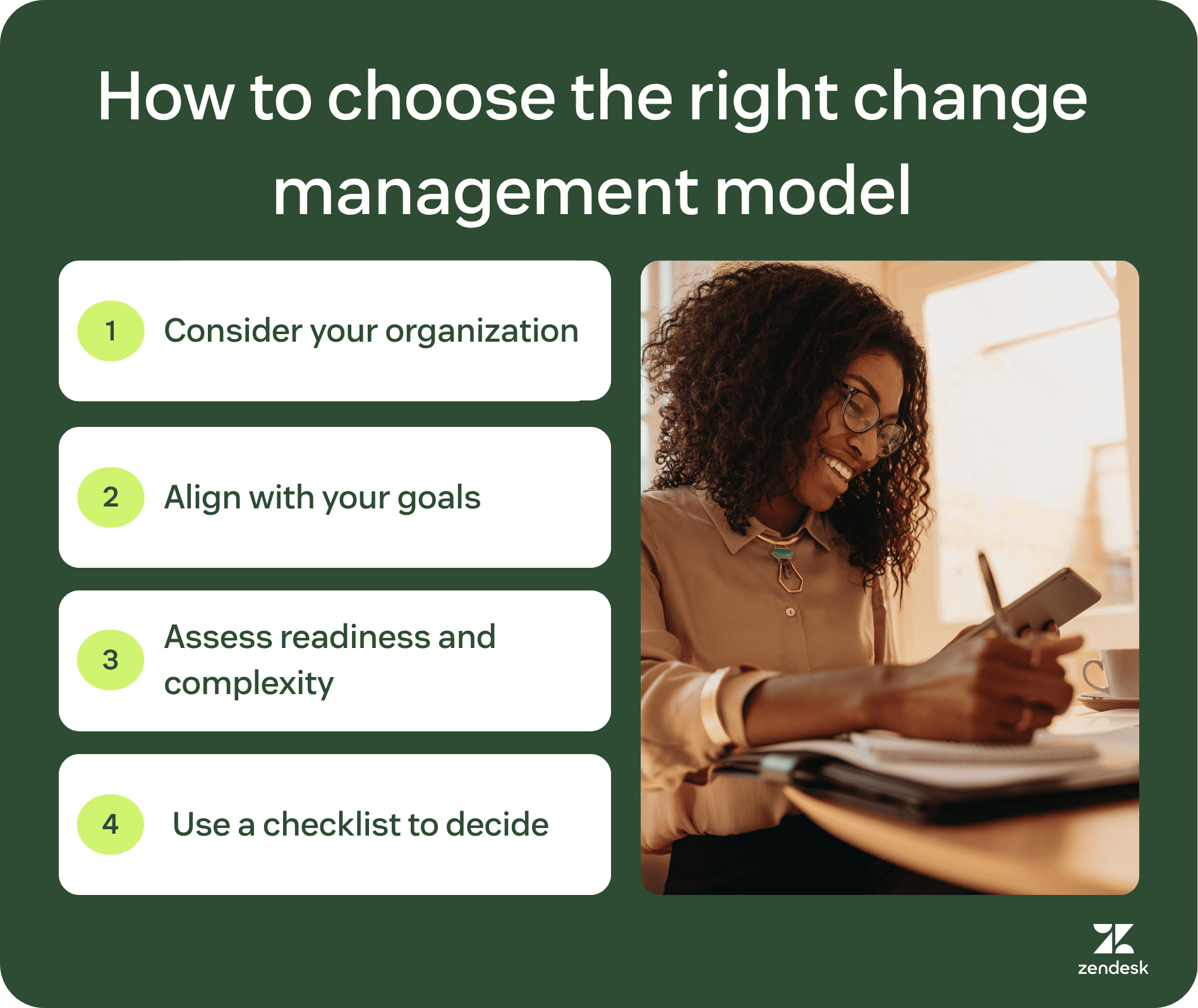
Choose the model that fits your organization
There’s no single change management model that works for every organization. The right approach depends on your structure, goals, and how your teams operate.
Many organizations combine multiple models to fit their needs. The best mix depends on the scope of change, company maturity, and technological complexity.
This flexible approach helps teams adapt to evolving systems, workflows, and expectations while maintaining consistency as they scale.
Align the model with business goals and change scope
Different types of change require different approaches. Start by identifying whether your change is strategic, cultural, or technology-driven.
Strategic changes focus on long-term goals, like scaling operations or improving efficiency. Cultural changes focus on behavior, adoption, and how teams work. Technology-driven changes involve new tools, systems, or AI, often adding complexity to workflows.
Choosing a model that aligns with your change type helps ensure the right balance of structure, flexibility, and adoption support.
Assess organizational readiness and complexity
Assess your organization’s readiness before choosing a change management model. Consider your company’s maturity, how prepared your employees are, the scale of the change, and the skills for change management your teams need.
Organizations with lower maturity or large, complex changes often need more structured models. More mature teams with strong adoption can use flexible approaches to adapt and iterate more quickly.
Use a practical checklist to select the right approach
Use this checklist to match your situation to the right change management approach. Consider your goals, type of change, and organizational readiness to choose the best model or combination.
Cultural change (e.g. mindset, behavior, adoption)
Employee engagement, resistance, communication
People-focused models like ADKAR or Bridges
Technology-driven change (e.g. new tools or AI-driven workflows)
System complexity, training needs, adoption speed
Blended approach combining ADKAR with process models such as Lewin or PDCA
Low organizational readiness
Limited experience with change, high resistance
More structured, step-by-step models such as Kotter or Lewin
High maturity and readiness
Experienced teams, strong adoption
Flexible or iterative models like PDCA
This approach will help you select the right model, or combination of models, based on your specific needs. Clear alignment makes it easier to manage complexity and drive consistent results.
Trends shaping change management in 2026
Change management in 2026 is more continuous, data-driven, and shaped by AI. Organizations now rely on real-time analytics and feedback loops to track adoption and guide decisions. According to the Zendesk CX Trends Report, 87% of CX leaders say AI is already improving data and analytics, enabling faster, more informed change.
To keep pace, organizations are operationalizing change with clear ownership and measurable outcomes. Teams track KPIs like feature usage, task completion time, and adoption rates to understand impact. By securing executive support and delivering quick wins, they build momentum and reinforce change over time.
Frequently asked questions
The most effective change management models in 2026 include Kotter’s 8-Step Model, Lewin’s 3-Stage Model, ADKAR, McKinsey 7-S, and the Kübler-Ross Change Curve. Organizations often combine these frameworks to fit their goals, scale, and complexity.
Yes, combining multiple change management models is common for complex initiatives. Blending frameworks helps address both system-level changes and individual adoption challenges for more effective results.
AI enables organizations to personalize change support and monitor adoption in real time. It helps teams identify risks, optimize interventions, and improve outcomes while keeping a strong human focus.
Measure success by tracking adoption rates, feature usage, time-to-task, and support trends. These metrics show whether changes are effective and where teams need to adjust.
Support change at scale with Zendesk’s AI-powered employee service solution
Zendesk’s AI-powered employee service solution helps teams turn strategy into action by streamlining workflows, centralizing support, and guiding employees through change in real time.
With AI-driven automation, real-time insights, and a unified workspace, organizations can reduce friction, drive adoption, and maintain consistent experiences at scale. Start your free trial today.
Justine Caroll
Director, Product Marketing
Justine is a product marketing leader with 15+ years of experience in B2B SaaS and consumer technology. She leads Zendesk's Employee Service product marketing team, helping departments like IT and HR deliver exceptional service through AI-powered, easy-to-use tools. Her favorite part of the job? Launching products that truly help customers and deliver real impact.
Scale change with Zendesk AI
Turn strategy into action with AI-powered employee service built for real-world change.