Vice President, Product Marketing, AI and Automation
Last updated July 6, 2026
What is AI in customer service?
AI in customer service refers to the use of intelligent technology to deliver fast, efficient, and personalized support at scale. AI-powered tools automate repetitive tasks, route requests intelligently, and equip agents with real-time context and recommendations. By connecting data, workflows, and knowledge, AI enables organizations to resolve issues faster, reduce costs, and maintain consistent service quality across every interaction.
AI in customer service is reshaping what customers expect from every interaction. Speed, personalization, and accuracy are now baseline requirements, yet many teams still struggle to deliver them consistently at scale. The Zendesk CX Trends Report revealed that 67% of consumers expect more personalized service now that AI can analyze their interactions.
AI bridges that gap by turning support into a resolution engine. It surfaces the right context, taking action across systems, and driving faster, more consistent outcomes through customer experience automation (CXA).
As Zendesk CEO Tom Eggemeier puts it, AI “resolves more issues through automation, enhances agent productivity, and delivers more accurate, personalized service.”
In this guide, we break down how AI in customer service works—and how it drives better outcomes for teams and customers alike.
While AI improves the customer experience, it also brings significant business benefits. Here are some top advantages of incorporating artificial intelligence into customer service.
Lowered costs: AI can decrease customer service costs by automating routine tasks and inquiries, empowering support teams to resolve more issues with fewer resources. It also enables more efficient resource allocation, freeing the team to focus on higher-value work.
Improved customer satisfaction: Fast and convenient service is critical to gaining loyal customers. AI agents or chatbots can deliver 24/7 support, decreasing hold times and increasing customer satisfaction.
Boosted agent efficiency: AI handles tedious tasks, reducing the manual workload for customer service teams. With that time back, agents are more likely to apply themselves to meaningful, high-stakes tasks.
Increased productivity and efficiency: AI agents provide instant support without involving a human agent. If a handoff is necessary, AI Copilot guides the live agent with insights and suggested actions, which leads to faster resolution times.
Optimized operations: AI can suggest which service inquiries are best suited to automation and optimize workflows, enabling support teams to streamline their operations.
Personalized experiences: AI shares customer insights with agents and equips them with the information they need to personalize solutions based on each customer’s unique needs.
Higher demand capacity: AI agents handle all types of customer requests over any channel, helping teams effectively manage high support volumes.
As AI in customer service continues to evolve, we anticipate that 100 percent of service interactions will incorporate AI in some form. These benefits highlight why intelligent technology is here to stay.
The importance of AI in customer service
Customer service has shifted from a cost center to a core driver of customer loyalty and growth. As expectations rise and support volumes increase, teams need a way to deliver fast, consistent service without adding complexity or headcount. AI enables organizations to meet these demands while improving both efficiency and experience.
Rising expectations are redefining service standards
Customers now expect immediate, personalized support across every channel, at any time. AI has raised the bar, making fast and accurate resolutions the new baseline rather than a differentiator. Even so, many support teams still operate with fragmented tools and limited visibility, which slows response times and creates inconsistent experiences. As a result, legacy service models struggle to keep pace with modern customer expectations.
Intelligent automation unlocks faster, scalable support
AI enables teams to automate high-volume, repetitive requests and route complex issues with precision. This reduces manual work, shortens resolution times, and allows agents to focus on higher-value interactions. With AI handling routine tasks, support teams can scale operations without increasing headcount or sacrificing quality. The result is faster service for customers and more efficient workflows for teams.
Customer experience becomes a driver of competitive growth
AI transforms customer service into a source of insight and continuous improvement. By analyzing interactions at scale, teams can identify trends, surface customer needs, and address issues before they escalate. This shift from reactive support to proactive service strengthens customer relationships and reduces churn. Organizations that operationalize these insights gain a measurable advantage in both customer satisfaction and long-term growth.
11 examples of AI in customer service
AI in customer service has moved beyond experimentation, but many teams still struggle to apply it effectively. These examples show how AI drives faster resolutions, improves efficiency, and scales service operations.
1. Leverage AI agents
AI agents—the next generation of AI-powered bots—handle complex customer requests from start to finish. Powered by conversational AI, they understand intent, ask follow-up questions, and resolve issues without human intervention. For example, Zendesk AI agents can automate up to 80 percent of customer interactions, freeing human agents to focus on higher-value work.
Unity, the world’s leading platform for real-time 3D content, deployed an AI agent to manage ticket volume and deliver instant answers. By connecting the agent to its knowledge base, Unity deflected 8,000 tickets and saved $1.3 million.
2. Proactively guide agents
AI-powered assistance tools improve agent productivity and efficiency by delivering real-time recommendations during conversations. Agents receive suggested responses, next steps, and relevant context, which significantly speeds up resolution time.
For example, Zendesk Agent Copilot guides agents through every interaction. “With Zendesk AI Copilot in their corner, every human agent will know exactly what to say and do at every step,” says Eggemeier.
3. Automate workflows
AI automates core support workflows, reducing manual work and accelerating resolution times. It routes tickets based on intent, summarizes conversations instantly, and suggests responses grounded in context.
Esusu, a financial technology platform, uses Zendesk AI to streamline operations. “The summarization feature has been a huge help,” says Jessica Hannes, director of support. “It saves time and allows us to work more efficiently.”
4. Optimize workforce management
AI-powered workforce management (WFM) improves staffing accuracy and operational efficiency. By analyzing historical trends, AI predicts demand, reduces overtime, and aligns staffing with real-time needs.
It also automates scheduling and adapts shifts based on agent availability and workload, giving managers more control while reducing administrative effort.
5. Improve service quality
AI in customer service quality assurance (QA) evaluates every interaction to identify risks, gaps, and coaching opportunities. It replaces manual sampling with full visibility across channels, languages, and teams.
For example, Rentman uses Zendesk QA to analyze interactions and deliver targeted feedback. This approach improved agent performance, increased engagement, and helped achieve CSAT scores of around 93 percent.
6. Enhance call management
Customers still rely on phone support for complex issues. AI call center solutions reduce handling time by generating call summaries, transcribing conversations, and scoring interactions automatically.
AI also shifts volume away from voice by resolving requests across messaging, email, and social channels, reducing pressure on call centers.
7. Improve your help center
AI strengthens your help center by identifying content gaps, updating outdated articles, and generating new content based on real support data. It also improves discoverability through smarter search and recommendations.
AI agents use this knowledge to deliver accurate, contextual answers during interactions, reducing ticket volume and enabling customers to resolve issues on their own.
8. Turn your cost center into a revenue generator
When AI connects to backend systems like CRM and e-commerce platforms, support interactions become revenue opportunities. AI can recommend products, trigger upsell prompts, and personalize offers based on customer behavior.
It can also send proactive messages tied to customer actions, increasing conversion rates while maintaining a seamless support experience.
9. Get insights to improve
AI analyzes customer conversations at scale to uncover trends, recurring issues, and operational gaps. These insights enable AI-driven customer feedback analysis, helping teams identify patterns and act on customer needs faster.
With continuous analysis, teams shift from reactive support to proactive optimization, improving efficiency and customer outcomes over time.
10. Analyze customer sentiment in real time
AI detects customer sentiment during interactions, identifying frustration, urgency, or satisfaction as conversations unfold. This allows teams to prioritize high-risk cases and respond appropriately.
Agents receive alerts and guidance based on sentiment signals, which improves response quality and reduces escalation rates.
11. Ensure consistent support across all channels
AI standardizes responses across email, chat, voice, and social channels. It applies the same knowledge, tone, and policies to every interaction, reducing variability in service quality.
This consistency builds trust, strengthens brand perception, and ensures customers receive reliable support regardless of channel.
Top AI customer support platforms
AI customer support platforms vary in their strengths. Some are built for ecommerce, others for enterprise-scale service operations, while some focus on simplicity for growing teams. The right choice depends on your support channels, AI requirements, integration needs, and long-term growth plans. Here's a quick comparison to help narrow your options.
The best AI customer support platform delivers more than automation. Evaluate solutions based on AI capabilities, omnichannel support, integrations, reporting, scalability, and total cost of ownership—not pricing alone. Choosing a platform that grows with your business can reduce complexity and improve customer experiences over time.
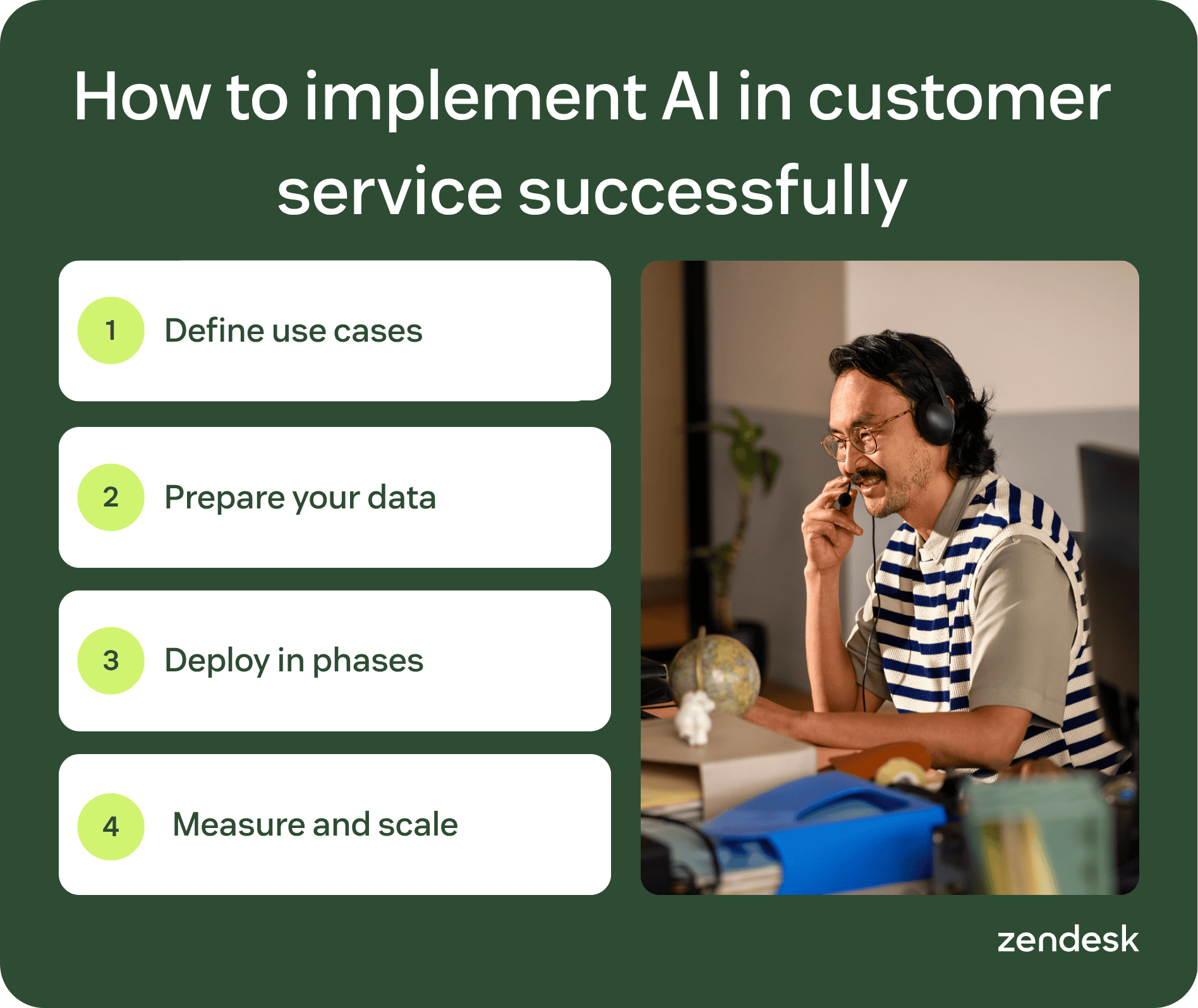
How to implement AI in customer service successfully
Implementing AI requires a clear strategy, strong data foundations, and continuous optimization. The most successful teams start small, measure impact, and scale intentionally.
Define use cases and success metrics
Start by identifying high-impact use cases tied to common bottlenecks, such as ticket triage, FAQs, or agent assistance. Focus on areas with high volume and clear ROI potential.
AI performance depends on data quality. Audit your knowledge base, ticket history, and customer data to ensure accuracy and consistency. Connect key systems like CRM, help centers, and internal tools so AI can access the context needed to resolve issues effectively.
Deploy in phases with human oversight
Roll out AI gradually, starting with simple use cases like FAQ automation or ticket routing. Keep humans in the loop to review outputs and handle edge cases. As confidence grows, expand to more complex workflows while maintaining oversight and control.
Monitor performance and scale gradually
Track performance continuously using key metrics and QA insights. Identify gaps, refine workflows, and improve accuracy over time. Use feedback loops and governance controls to scale responsibly, ensuring AI continues to deliver reliable, high-quality support as adoption grows.
The future of AI in customer service
AI is shifting customer service from reactive support to proactive resolution. It detects patterns, predicts issues, and resolves problems before customers even reach out. This reduces ticket volume and improves satisfaction across the journey.
Multimodal and multilingual AI will unify voice, chat, and messaging into one seamless experience. At the same time, AI will handle routine work while humans focus on complex cases. With oversight and quality controls, teams scale service while maintaining trust.
Frequently asked questions
Choosing the right AI for customer service requires more than automation—it depends on cost, accuracy, speed, and trust. The best solutions deliver fast time to value, reliable performance, and strong data protection without heavy technical overhead.
Key considerations:
Budget and resources: Choose AI that deploys quickly without requiring large teams, custom builds, or ongoing manual training.
CX expertise and accuracy: Prioritize AI trained on real customer service interactions to ensure accurate, context-aware responses.
Time to value: Look for solutions that go live quickly and deliver impact in days—not months.
Security and compliance: Ensure the platform meets strict data privacy, governance, and compliance standards.
Businesses use AI in customer service to automate workflows, assist agents, and streamline experiences. AI can provide:
AI will not replace customer service but will transform customer interactions. As adoption accelerates, AI is becoming embedded across the entire service journey, from routing and agent assistance to automated resolution. According to the Zendesk CX Trends Report, nearly 90% of CX leaders expect AI to resolve most customer issues in the coming years, reinforcing a model where AI handles routine work and humans focus on complex interactions.
Businesses can use AI to engage customers in various ways, including:
Personalizing interactions
Optimizing help center content
Recommending solutions based on customer needs
Responding to customers conversationally in real time
You can keep your data secure when using AI for customer service by:
Prioritizing end-to-end encryption
Regularly auditing security measures
Using transparent AI algorithms
Excluding identifiers from training datasets
Tokenizing data so it is only readable by machines
When comparing AI customer service software, look beyond the number of available features. Evaluate how easy the platform is to implement, the maturity of its AI capabilities, its automation features, integrations, reporting, governance controls, pricing model, and ongoing operational requirements.
The right solution should fit your team's workflows today and scale as your business grows. Focus on platforms that improve resolution speed, reduce operational costs, and support long-term adoption—not just those with the longest feature list.
Get the complete CX solution for the AI era
AI is transforming customer service, but the goal remains the same: deliver experiences that feel consistent, personal, and human. The challenge is scaling that level of service without adding complexity or cost.
The Zendesk Resolution Platform powers a unified customer service solution that brings AI, knowledge, and workflows into one place. It resolves issues faster, improves consistency, and gives teams the control and visibility they need to scale with confidence. Ready from day one, it delivers immediate value without lengthy setup—while maintaining the security and governance modern businesses require.
How Fortnum & Mason uses Zendesk AI to elevate service
“I love that the AI really understands the tone and context of customer inquiries. It knows when to escalate a ticket to a live agent—that way, our agents can really focus on customers with more complex interactions.”
Vice President, Product Marketing, AI and Automation
Candace Marshall is a seasoned product marketing leader with a passion for solving complex problems and driving innovation in fast-paced environments. Her career began in operations and research, but her love for understanding customers and translating insights into impactful strategies led her to product marketing. Currently, Candace leads product marketing for Zendesk AI including AI agents and Copilot, driving growth across AI-powered solutions and the core service offerings. Her team delivers end-to-end product marketing strategies, from market validation and messaging to go-to-market execution and customer adoption. Before joining Zendesk, Candace spent nearly a decade at LinkedIn, where she built and led the product marketing team for the rapidly scaling Marketing Solutions division, overseeing key advertising products in the multi-billion-dollar business.
Explore the Zendesk Resolution Platform
Unify AI, knowledge, and workflows to resolve issues faster and scale support with confidence.