Article • 3 min read
The contact center’s next chapter is agentic
The strategic roadmap for contact centers is changing dramatically, and there's three major shifts you need to be aware of.


Jonathan Barouch
Vice President and General Manager of Contact Center at Zendesk
Senest opdateret March 18, 2026


The ‘cost center’ label has been the limiting narrative for CX leaders for decades. For years, the mandate was simple: handle the volume, keep the headcount lean, and try not to break the budget.
But the math has changed. Recent data from our research of over 1,000 contact center leaders shows that 92% of them now view the contact center as a direct driver of revenue growth. The shift from reactive complaint handling to proactive value generation isn’t just a goal, it’s already happening.
However, there is a mounting tension. While the vision for the future is ambitious, the infrastructure holding it up is often decades old. We’ve reached an inflection point where traditional staffing and legacy “omnichannel” setups are hitting a ceiling.
Here are three shifts currently redefining the strategic roadmap for the next three years.
1. The death of the “wait for the customer” model
The most significant change in the coming years isn’t just faster responses, it’s the elimination of the “inbound” trigger altogether.
We have consistently observed a move toward proactive and predictive support and currently, 86% of leaders believe AI-powered proactive outreach fundamentally flips the support model. The goal is now for support that is always on, working seamlessly in the background. When support happens for the customer rather than being sought out by them, loyalty ceases to be a metric and becomes a default.
2. Voice isn’t dying, it’s leveling up
For years, the industry predicted the “death of voice” in favor of cheaper digital channels. The data tells a different story: Voice still accounts for 40% of contact center volume, outstripping email, chat, and social media.
Customers aren’t calling because they want to; they’re calling because the stakes are high. They turn to voice for issues that are emotionally charged, technically complex, or time-sensitive.
The future is now about multimodal fluidity. Leaders are now investing in systems where a customer can start in a chat, move to a voice call, and transition into a screen-share session without ever losing context or having to re-authenticate.
3. Staffing for complexity, not volume
As AI moves from summarizing notes to autonomously resolving actions, the role of the human agent is undergoing a forced evolution. We see a shift in workforce design:
- From generalists to specialists: Teams are becoming leaner and more expert-led.
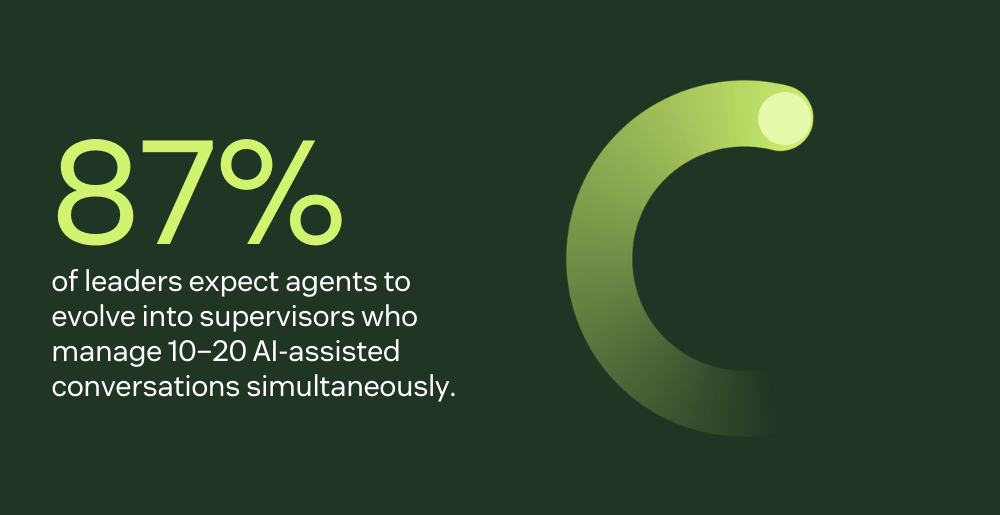
- The rise of the AI supervisor: 87% of leaders expect agents to evolve into supervisors who manage 10–20 AI-assisted conversations simultaneously.
- Outcome-based metrics: Success is moving away from “Average Handle Time” toward Quality of Resolution and emotional outcomes.
If AI handles the 80% of tier-one queries that used to slow the system, the remaining 20% of human interactions will be the most difficult, sensitive, and high-value moments your brand has.
The gap between vision and reality
Identifying where you want to go is the easy part. The friction lies in the 75% of leaders who say legacy systems prevent them from delivering this seamless experience.
The transition to an “agentic” contact center, one where AI doesn’t just suggest answers but autonomously completes tasks, requires a fundamental rethink of your tech stack and your talent.
Our latest report, The Leader’s Guide to the Agentic Contact Center, breaks down the six core components of this new model and provides insights for workforce redesign and technology investment.