Article • 5 min read
5 superpowers AI gives startup teams
From centralized communication to actionable insights, the AI turbocharge effect is invaluable for startups.


Jenna McCrory
Group Manager, Global Startup Marketing at Zendesk
Senast uppdaterad February 25, 2026


Think adopting AI is all about immediate ROI? That may be true for some CX teams, but not necessarily startups.
Our 2026 CX Trends report found that investing in AI is a strategic requirement for startups, even before the full financial picture is clear. In fact, nine in 10 (89%) startup leaders say AI is a competitive necessity, even without clear ROI.
So, why are startup leaders so bullish on AI? Beyond the buzz around coding and technical velocity, AI supercharges teams, giving them the power to reduce cost and resources spent on menial tasks—allowing them to focus on delighting customers and reducing churn. Startup leaders who’ve adopted AI say the benefits are clear: 93% report a positive ROI on their overall AI for customer service investments over the last 12 months.
With AI, startup teams have the power to:
1. Operate from a unified command center
In fast-moving startups, data siloes crop up. This leads to disjointed channels and fragmented knowledge, hindering consistent communication with customers. A lack of formal processes further increases fragmentation and the potential for duplicity.
With AI, startup teams can centralize communication and offer omnichannel support– stitching email, chat, social, SMS into a single view. Teams can see the full customer story at a glance, eliminating silos and delivering a personalized experience.
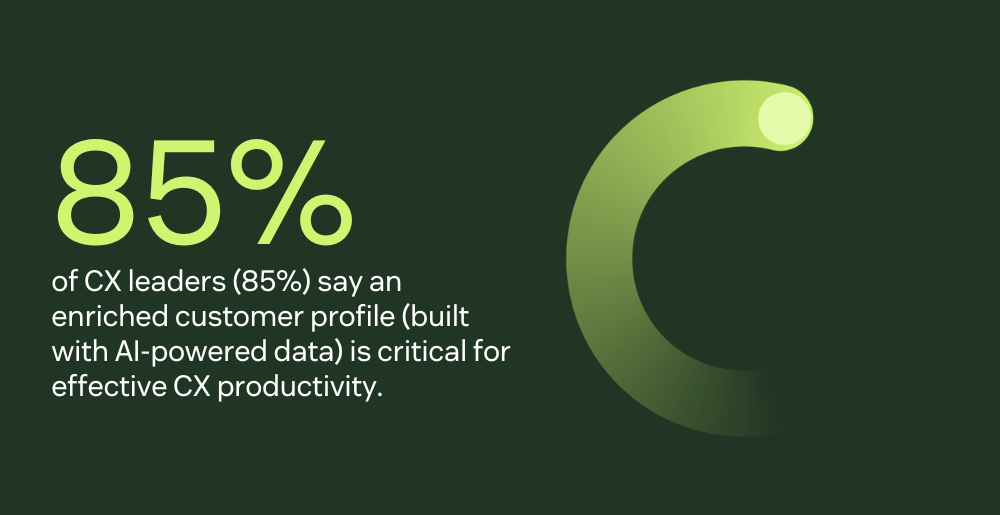
Most startup CX leaders (85%) say an enriched customer profile (built with AI-powered data) is critical for effective CX productivity. More than two-thirds have already made the investment: 69% say their organization currently uses AI to personalize the customer experience.
2. Collaborate intelligently
Teamwork makes the dream work— that certainly rings true at a startup. Coordinated efforts lead to better service. But when folks get busy, clear and consistent knowledge sharing can falter. And customer experience suffers.
With the power of AI, startup teams gain shared visibility. From summarizing tickets to tagging experts to surfacing similar cases, AI gives teams instant context so they can provide consistent answers to customers.
Plus, intelligent triage empowers startup teams to take interactions to the next level, ensuring conversations are routed to the team member who can solve an issue most effectively.
3. Cut response times and automate routine tasks
Any CX leader will tell you one of their top goals is reducing response time. It’s also one of the key metrics leaders measure, as faster replies improve customer satisfaction.
Enter: AI turbocharge. With AI-powered triage and reply suggestions, teams can cut response times from minutes to seconds. AI agents are also a great tool for startup teams. They’re highly effective at handling repetitive questions and tasks (think: password resets or refund requests), enabling human agents to tackle higher-value interactions.
It’s a win-win: support teams handle volume more efficiently, while customers get better service. Nearly all (95%) startup CX leaders now consider AI part of their workforce and team.
4. Scale customer support operations
We hear you: your customer base is growing, but you don’t have the headcount to support it.
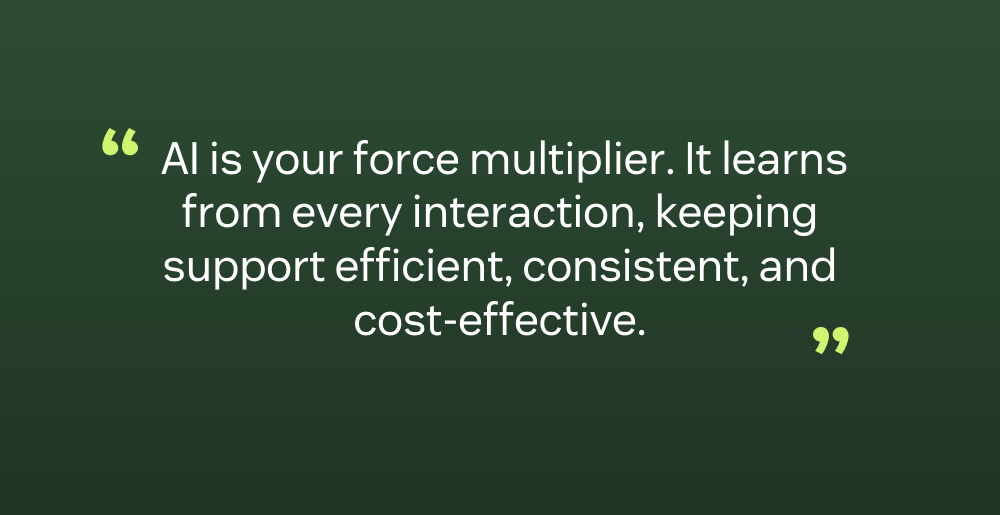
Here’s where AI is your force multiplier. It learns from every interaction, keeping support efficient, consistent, and cost-effective no matter how fast your customer base expands. As mentioned above, AI agents step in to handle routine requests, so your teams can tackle the more complex or sensitive ones. Tools like Copilot also free up bandwidth by gleaning insights about the customer, helping customer-facing folks know what to say and how to decide on the best course of action.
Keep in mind, the right CX solution will mature with you, allowing you to add more advanced features when the time is right. Our advice? Look for scalable pricing models. Opting for a pay-as-you-grow approach reduces upfront investment risk. This approach is particularly useful for startups experiencing sudden influxes of customers, with a less predictable trajectory than other businesses.

5. Gain and amplify actionable insights
Like any CX-focused team, startups need access to data to understand customer needs and behavior. AI transforms every customer interaction into actionable insights: spotting recurring issues, feature requests, sentiment shifts, and more to help guide smarter CX decisions.
Many leaders already see the benefit: 92% of leaders say AI is already significantly improving data and analytics.
Other teams get a leg up from these insights, too. Product, marketing, and sales teams all benefit from access to AI-powered CX data. Plus, better insights makes reporting to their investors easier, too.
A lean team doesn’t have to mean low impact. Empowered with the right tools, startup teams not only supercharge their customer support—they compete with companies many times their size.
Common questions startup leaders ask about AI in customer support
1. How can AI help startups centralize and scale customer support as we grow?
AI unifies every communication channel into one command center, then scales effortlessly as volume increases. It routes conversations intelligently, automates repetitive work, and maintains consistent quality no matter how fast your customer base expands.
2. Can AI improve collaboration and response times for startup teams?
AI assists customer-facing teams with real-time summaries, suggested replies, and knowledge surfacing. It connects the dots across teams, ensuring faster, coordinated responses without sacrificing accuracy or empathy.
3. Can I use AI to generate insights from customer interactions?
Using AI, startup teams can quickly analyze every conversation to reveal trends, such as common issues, sentiment shifts, and feature requests. This allows startups to make data-driven improvements in product design, messaging, and overall customer experience.


