



What is technical debt?
Technical debt refers to the future cost of reworking code as a consequence of taking a shortcut to deliver a solution quickly. The term was created by software developer Ward Cunningham as a metaphor for financial debt. A loan gives you money instantly, at the cost of high interest rates. Likewise, creating workarounds to release software faster is the quick solution, but long-term improvements are needed later.
It’s a familiar feeling. You need to solve a problem right now, so you take the quickest path despite knowing that the real, proper fix will cost more later. Like interest in a financial debt, technical debt in software development is the price you pay for creating workarounds to release a solution that isn’t optimal yet.
Workarounds solve problems today, but they generate accumulated tech debt tomorrow. Future ongoing maintenance and the costs of poor code directly impact employee experience (EX) and customer experience (CX). Engineers often reworking messy code spend more time fixing bugs than building new value, affecting employee experience management.
For the customer, this translates to inconsistent features, slower response times, and an unreliable product. This is why effective technical debt management isn’t just an engineering concern—it’s a critical business imperative for sustained speed, stability, and high-quality service.
Keep reading to find out more about the key types of technical debt, its impact, and how to effectively manage it.
More in this guide:
- Key types of technical debt
- The impact of technical debt
- How to effectively prevent and manage technical debt
- Frequently asked questions
- Building for the long term with Zendesk
Key types of technical debt
Like financial debts, there are various types of technical debt. All have one thing in common: the longer they’re left unmanaged, the more maintenance headaches and slowed development they will cause.
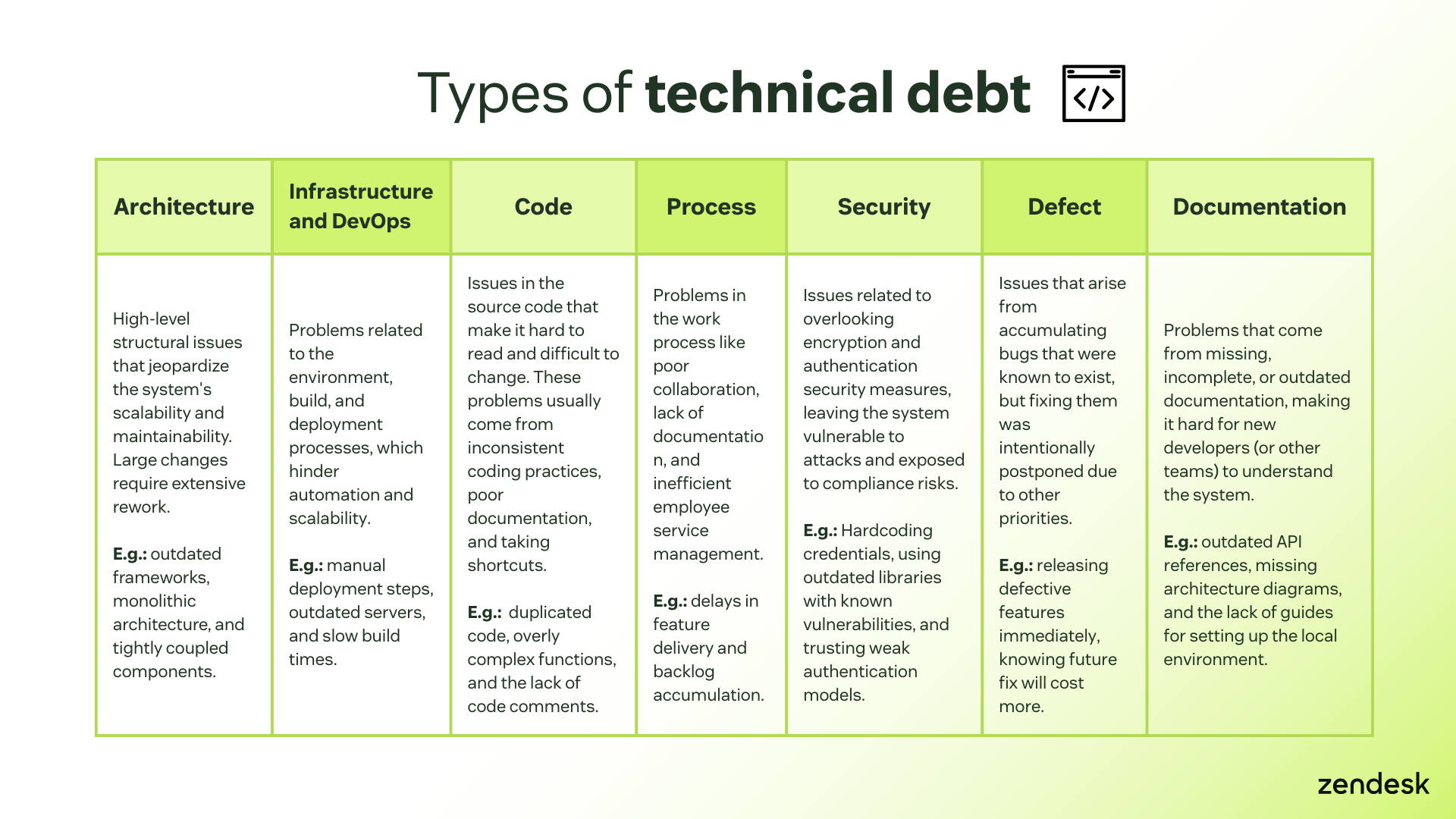
The main technical debt types classified by location (the area of the system that needs rework) are:
- Architecture debt: High-level structural issues that jeopardize the system’s scalability and maintainability. Large changes require extensive rework. Outdated frameworks, monolithic architecture, and tightly coupled components are some examples.
- Infrastructure and DevOps debt: Problems related to the environment, build, and deployment processes, which hinder automation and scalability. The examples include manual deployment steps, outdated servers, and slow build times.
- Code debt: Issues in the source code that make it hard to read and difficult to change. These problems usually come from inconsistent coding practices, poor documentation, and taking shortcuts. Some examples are duplicated code, overly complex functions, and the lack of code comments.
- Process debt: Problems in the work process like poor collaboration, lack of documentation, and inefficient employee service management, leading to delays in feature delivery and backlog accumulation.
- Security debt: Issues related to overlooking encryption and authentication security measures, leaving the system vulnerable to attacks and exposed to compliance risks. Hardcoding credentials, using outdated libraries with known vulnerabilities, and trusting weak authentication models are some examples of security debt.
- Defect debt: Issues that arise from accumulating bugs that were known to exist, but fixing them was intentionally postponed due to other priorities. The teams make the decision to release the feature immediately, with the bugs, knowing they’ll have to fix them later at higher costs.
- Documentation debt: Problems that come from missing, incomplete, or outdated documentation, making it hard for new developers (or other teams) to understand the system. Examples include outdated API references, missing architecture diagrams, and the lack of guides for setting up the local environment.
The impact of technical debt
When engineers are constantly battling brittle, messy code, innovation slows down and morale drops. Instead of focusing on new solutions, they have to spend much of their time untangling errors that shouldn’t exist in the first place.
Additionally, failing to manage tech debts leads to an underlying codebase that’s increasingly difficult and costly to maintain. The impacts of technical debt are:
- Slower development velocity and innovation: Developers are left with no time or energy for innovation. They may be able to juggle new projects while fixing existing ones, but frequent focus-shifting inevitably leads to delayed development and progress.
- Reduced team morale and productivity: As developers’ time and energy is pulled into fixing problems, tasks start piling up and the joy of building new value fades. The result of this is increasingly unengaged employees who are more likely to make mistakes. Companies then face inconsistent features and slower deliveries, which reflect in employee retention rates, customer service, and the final product.
- Increased bugs, maintenance costs, and operational risks: Poorly structured and undocumented code is far more prone to errors, leading to a constant cycle of hotfixes and higher maintenance costs. The risk of major operational failures, such as outages and data loss, increases as it becomes harder to predict how changes will affect the brittle core system.
- Potential compliance or security issues: Complex, undocumented code makes it incredibly difficult and time-consuming to audit the system. So, it becomes a challenge to ensure it meets increasingly strict industry regulations and compliance standards like GDPR or HIPAA.
How to effectively prevent and manage technical debt
To promote a work environment where teams can focus on building new features and enhancing existing ones, technical debt must be continuously managed. Here are a few tips to help you.
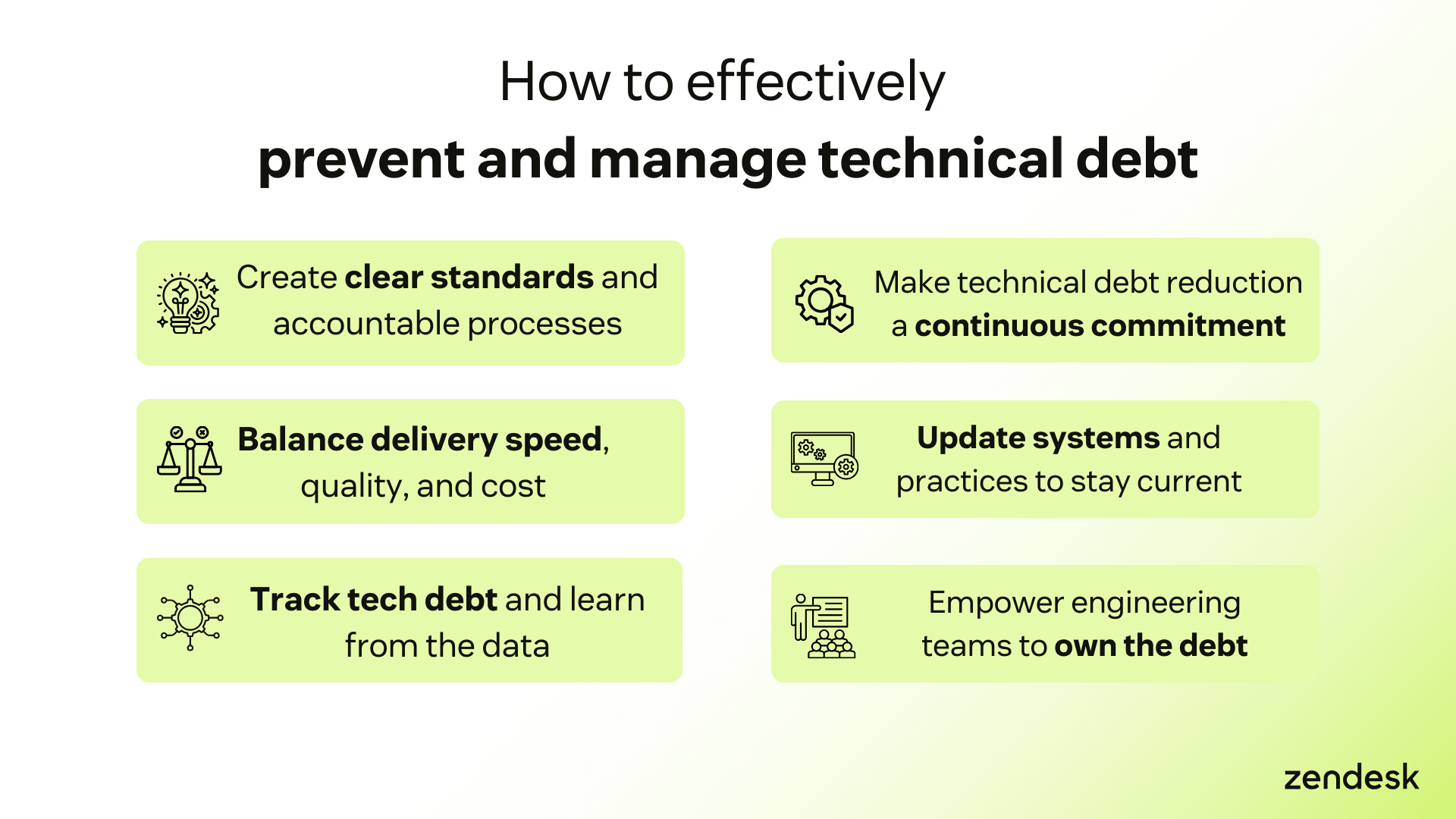
Create clear standards and accountable processes
Technical debt isn’t always anticipated. When coding standards and workflow processes aren’t clear, unintentional tech debts can arise. Setting clear coding standards, review processes, and architectural guidelines stops technical debt in its tracks. Make sure the entire engineering team agrees with these guidelines and regularly reinforce them through scheduled code reviews and pair programming.
It’s equally important to set accountable processes to ensure no pull requests are accepted if they introduce significant new debt. This makes managing and preventing tech debt a shared and constant responsibility, rather than a secondary concern.
Balance delivery speed, quality, and cost
Speed, quality, and cost are the three most discussed characteristics of any project. Every team wants to deliver a high quality, inexpensive project in no time. But in the real world, reaching these three goals at once is almost impossible.
It’s important to find a balance between delivering a feature in a reasonable time, without requiring exorbitant financial resources. But the main takeaway is that under no circumstances should you sacrifice quality—unless you’re willing to pay for insanely high ‘interest’.
Empower engineering teams to own the debt
Accountability plays an important role in technical debt management. It’s only fair that the teams responsible for building and maintaining the code own and resolve the debt. This means allocating dedicated time for maintenance and refactoring—and ensuring that engineers have the final say on the technical roadmap.
Most importantly, empowering engineering teams to own the debt is about giving them the authority to prioritize quality—not punishing them for potential tech debts or for slowing down to fix foundational issues. When they don’t fear taking the time needed to fix these issues they are far more likely to maintain a healthy codebase. Effective employee development plans should incorporate training on best practices for managing this debt.
Update systems and practices to stay current
The software world moves fast. Best practices of two years ago are now outdated, which is another reason why tech debts arise. So, a proactive approach is the best way to keep systems, frameworks, and best practices current.
Dedicate time for regular, small updates, consistently research and adopt modern practices, and deploy up-to-date system performance enhancements offered by new technologies. This directly impacts the digital employee experience of your engineers.
Track tech debt and learn from the data
It’s impossible to manage tech debt without tracking it. Acting proactively and using tools to track technical debt allows engineers to identify and mitigate risks. Technical debt tracking tools are also essential to quantify the existing debt and integrate these metrics directly into the development workflow.
By regularly analyzing the debt, you can identify the areas in which suboptimal code is contributing to long-term maintenance issues. Learning from this data allows you to adjust standards, allocate resources better, and prevent repeated types of debt from occurring.
Make technical debt reduction a continuous commitment
To reduce technical debt, it must be addressed continuously as part of the development process, with full commitment from the team as a whole.
One approach is to motivate every engineer on the team to consider ways to reduce technical debt whenever they touch a piece of code. Advise them to spend a few minutes cleaning up surrounding code smells, improving documentation, or adding a missing test, ensuring the codebase is constantly being improved. You should also promote effective employee communication regarding project status and priorities.
Frequently asked questions
Building for the long term with Zendesk
Technical debt is a natural part of software evolution, but it needs to be managed intentionally to keep teams agile and systems healthy. By combining the right mindset, modern tools, and sustainable practices, organizations can turn technical debt into progress. Zendesk helps teams move fast without sacrificing quality. Our AI and automation tools streamline workflows, reduce maintenance burdens, and support scalable customer experiences.
Start your free Zendesk trial today to see how you can build for the long term with less technical debt.
