Guest post • 4 min read
The quiet shift behind customer expectations
Instant resolution is becoming the new measure of confidence.


Kevin Rotairo
Senior Director at Concentrix Philippines
Ultimo aggiornamento March 4, 2026


For a long time, speed shaped the customer service conversation. Faster responses signaled attentiveness. Shorter queues suggested care. Operating models were built around improving first reply times and reducing wait states.
But customer expectations rarely change all at once. They shift quietly, shaped by everyday experiences across digital services, commerce, and work. Over time, those experiences redefine what “good” looks like.
Today, that shift is clear. Customers no longer evaluate service based on how quickly a brand responds. They judge it by whether the issue is resolved accurately and completely, with minimal effort and without unnecessary handoffs.
Recent industry research reflects this change. Zendesk’s CX Trends Report 2026 highlights a sharp decline in tolerance for unresolved issues, with a significant majority of CX leaders indicating that customers will leave a brand after a single unresolved interaction. The implication is not simply higher expectations, but a redefinition of what customers now consider acceptable.
From responsiveness to resolution
The rapid adoption of AI-powered self-service has accelerated this shift.
Self-service was once viewed as a convenience, a way for customers to find information quickly or handle simple tasks. Escalation to a human was expected for anything complex.
As AI capabilities improved, so did customer assumptions.
When self-service interactions begin to understand context, retain memory, operate across languages and complete tasks end to end, customers stop distinguishing between channels. They expect resolution, regardless of whether they engage with a human or a system.
Zendesk’s research shows that fast and accurate resolutions increasingly influence purchasing decisions. Customer service now plays a direct role in trust, retention, and growth.
Why many self-service experiences still fall short
Despite significant investment, many self-service experiences struggle to meet these rising expectations.
They perform well in predictable scenarios and provide answers efficiently. But they often falter when real-world complexity enters the picture.
Policy exceptions, multi-step processes, dependencies across systems, language considerations, and customers returning with partial context all introduce friction that basic self-service models struggle to handle.
When this happens, customers experience progress without closure. They move through flows, receive responses, and still need to escalate. The effort invested feels wasted, and confidence erodes.
The challenge is not automation itself, but how well it is connected to the realities of the business.
Resolution is built in operations, not interfaces
Across industries, successful self-service outcomes tend to share the same foundations.
The limiting factor is rarely the conversational capability of AI. Most organizations now have access to capable tools. What differentiates outcomes is how intelligence is embedded into the operating model and connected across systems.
Three elements consistently shape whether self-service delivers resolution or merely response.
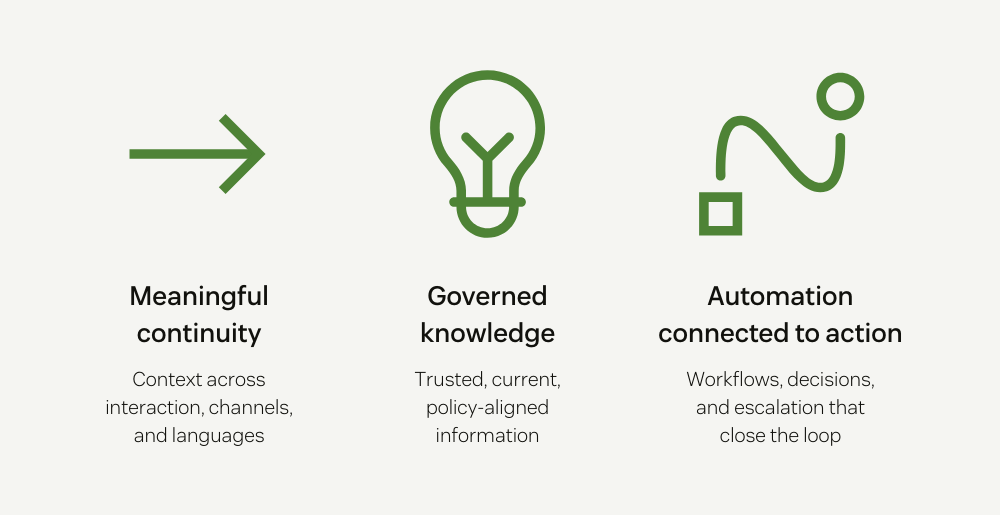
Meaningful continuity
Effective AI retains and applies the right context across interactions, languages, channels, and time. Not every detail, but the information that shapes decision-making.
What has already been attempted
The outcome the customer is seeking
The customer’s preferred language
Applicable constraints or policies
What has changed since the last interaction
This reflects contextual intelligence, where AI draws from interaction history, structured data, and policy context to support resolution rather than repetition.
Governed and trusted knowledge
In many organizations, knowledge is fragmented across functions. Product documentation, operational guidance, compliance rules, and regional variations often coexist without alignment. AI surfaces this fragmentation quickly and at scale.
High-performing organizations treat knowledge as an operational asset. It is governed, tested against real journeys, and updated in step with business change. As AI becomes more central to self-service, how documents and data are prepared increasingly determines resolution quality.
Automation connected in action
Resolution is rarely just informational. It involves triggering workflows, updating systems, applying policies, and escalating when judgment is required. Self-service succeeds when automation is aware of these workflows and able to act within them.
Zendesk’s research shows that organizations with higher AI maturity accelerate full resolution speed, not just first responses.
Designing self-service for real outcomes
Organizations that make meaningful progress tend to shift how they approach self-service design. In practice, they would:
start with intent rather than channels
operate effectively across languages
invest in a unified intelligence layer
design systems to support decisions, not just conversations
preserve human involvement for judgment and empathy
These shifts align closely with the direction highlighted in Zendesk’s CX Trends 2026, where resolution-based metrics and operational maturity increasingly define CX leadership.
Implications for CX leaders in Southeast Asia
In Southeast Asia, these dynamics surface quickly. Digital adoption is uneven and regulatory requirements vary. Customers are highly sensitive to friction, and switching costs are low.
Language complexity is another underestimated factor. In multilingual markets, self-service must operate reliably across languages without introducing inconsistency or additional effort.
In this context, resolution becomes a signal of reliability. Brands that rely on partial automation or disconnected experiences risk losing relevance quickly.
A quieter future for self-service
As expectations continue to evolve, the most effective self-service experiences will feel less visible, not more prominent.
Customers will not think about the channel, the AI, or the workflow itself. They will remember that the issue was resolved, without effort and without friction.
Instant resolution is no longer a differentiator. It is the baseline. The advantage lies in how consistently and confidently organizations can deliver it, even when conditions are complex.


