Understanding outcome-based pricing: A results-driven framework
Learn how outcome-based pricing ties AI investment to measurable results, so businesses can evaluate value based on what agents achieve, not just what they cost.


Candace Marshall
Vice President, Product Marketing, AI and Automation
Last updated April 2, 2026


What is outcome-based pricing?
Outcome-based pricing (OBP) is a value-based model in which sellers only charge customers after a defined, measurable result is achieved. Instead of paying for licenses, seats, or usage, they pay for tangible outcomes delivered. This approach shifts part of the performance risk to the seller and directly ties revenue to customer success.
Outcome-based pricing is a modern, results-driven pricing framework for software and services companies. Different from traditional models that charge for product or platform access, OBP ties payments directly to delivered business outcomes. In doing so, value is easier to measure and justify.
As businesses look for clearer returns from customer experience automation and AI software, outcome-based pricing is gaining traction. It’s especially relevant for AI agents, where success depends on what the technology resolves, completes, or improves.
For outcome-based pricing to work, both sides need a clear, meaningful, and tangible definition of success. This may include resolved customer service requests, completed workflows, and other measurable business results.
In this guide, we’ll explain how outcome-based pricing works, its benefits and challenges, and how to implement it strategically.
More in this guide:
- How outcome-based pricing works
- Key benefits of outcome-based pricing
- Common challenges in outcome-based pricing
- How to implement an outcome-based pricing strategy
- Frequently asked questions
- Power outcome-based pricing with Zendesk AI agents
How outcome-based pricing works
To function well, an outcome-based pricing model should be centered around clear definitions, reliable tracking, and pricing terms that reflect real business value. It also requires the right operational support across sales and finance. The actions below show how outcome-based pricing works in practice.
Define the outcome and success criteria
To avoid ambiguity in an outcome-based pricing agreement, both the seller and the buyer need to agree on the exact result that triggers payment. They should define the outcome in detail, which has to be specific, measurable, and tied to customer value.
This includes the success criteria, starting baseline, measurement period, and any exclusions that determine whether an outcome counts. The clearer the definition, the easier it is to measure performance and prevent disputes.
Implement tracking and verification systems
Once the outcome is defined, both sides need a reliable way to capture it. This often includes product instrumentation, shared dashboards, system integrations, and reporting workflows that show when outcomes are achieved.
Verification is just as important as tracking. Teams need a transparent process for validating data, resolving discrepancies, and confirming that each reported outcome meets the agreed criteria. Strong measurement systems make the model more credible and easier to scale.
Set a value-aligned pricing structure
After the outcome becomes measurable, the next step is setting the price for each verified result. The per-outcome rate should reflect the value delivered to the customer while supporting sustainable margins for the seller.
In some cases, a hybrid model works best. A company might combine a base platform fee with an outcome-based charge or add minimums and caps to reduce volatility. These safeguards help balance risk while keeping pricing tied to results.
Formalize terms and billing mechanics
Outcome-based pricing needs clear contract language. The agreement should define the outcome, explain attribution rules, set the billing cadence, and document how disputes will be handled.
It should also cover edge cases, such as partial outcomes, delayed verification, overlapping systems, or external factors that affect performance. Clear billing terms reduce friction and make the model easier to manage over time.
Align teams and financial operations
Outcome-based pricing isn’t just a commercial change. It often requires updates across sales, finance, operations, and billing systems.
Teams may need new compensation models, approval processes, forecasting methods, and revenue recognition workflows. Revenue depends on delivered results, not just fixed subscriptions, so internal alignment is essential for the model to work.
Key benefits of outcome-based pricing
Outcome-based pricing appeals to buyers because it links spending more closely to results. Instead of paying upfront for access alone, companies pay for measurable value delivered. This makes the model easier to justify internally and more attractive for AI, software, and service investments. Let’s explore the key benefits you can get from adopting an outcome-based pricing model.
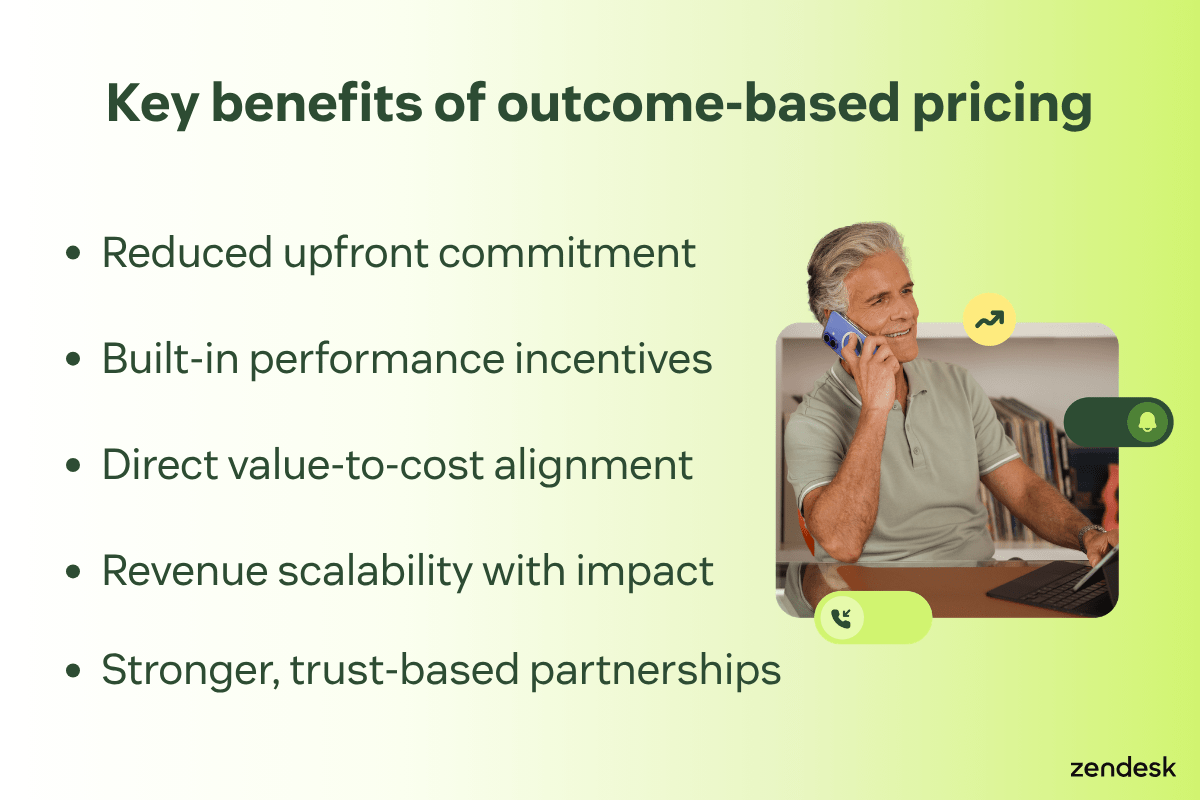
Reduced upfront commitment
Outcome-based pricing lowers the barrier to adoption because customers are not paying only for the promise of value. When spend is tied to achieved results, the financial and psychological risk feels lower than it does with large fixed subscriptions or long-term commitments. Without having to take a risk, teams are more likely to test a new solution, build internal support, and move forward with less hesitation.
Direct value-to-cost alignment
One of the biggest advantages of outcome-based pricing is that cost is easier to connect to business impact. Invoices reflect measurable results, which clearly shows teams what they are paying for and why it matters.
This visibility can make ROI conversations more straightforward. Finance and procurement teams are often in a stronger position to evaluate spend when pricing is connected to metrics like resolved requests, completed workflows, or other tangible results.
Built-in performance incentives
When revenue depends on outcomes, sellers are more compelled to deliver real customer success. Product, engineering, and customer teams have stronger motivations to focus on performance, reliability, and measurable results, not just product adoption. This alignment improves execution on both sides—the customer wants to achieve outcomes and the vendor is eager to make it happen.
Revenue scalability with impact
Outcome-based pricing can be hugely beneficial to vendors. In a flat-fee model, revenue is often capped even when the customer gets far more value than expected. In an outcome-based model, stronger customer results can support greater revenue growth.
This makes the model attractive when a product or service can drive meaningful business impact at scale. As outcomes increase, the commercial relationship can expand in a way that better reflects delivered value. In sum, it’s a win-win.
Stronger, trust-based partnerships
Paying for performance instead of promises can strengthen the customer-vendor relationship. Both sides need clear definitions, shared visibility, and mutual accountability, which encourages more transparency from the start. Over time, this can lead to stronger partnerships built on trust and proven results. When pricing is tied to outcomes, success becomes a shared goal rather than a one-sided claim.
Common challenges in outcome-based pricing
Although outcome-based pricing seems like a near-perfect alignment between spending and results, it can still create some challenges. The model depends on clear definitions, reliable measurement, and pricing structures that can withstand real-world conditions. Without this foundation, disputes, volatility, and operational strain can outweigh the benefits.
Outcome definition complexity
Determining the right criteria to define an outcome isn’t a simple task. In fact, one of the hardest parts of outcome-based pricing is choosing the right metric. The outcome needs to be meaningful enough to reflect real business value, but specific enough to measure consistently.
The metric can’t be too vague, otherwise it will create room for disagreement. It also can’t be too specific, as it may fail to capture the true impact of the product or service. The challenge is finding the perfect balance—an outcome that is both useful to the customer and practical to track.
Attribution and data disputes
Even when the outcome is clear, proving what caused it can be difficult. In many environments, results are influenced by multiple systems, teams, and external factors, making attribution harder to isolate. So, outcome-based pricing needs auditable tracking, shared reporting, and clear attribution rules. Without these, disagreements over what counts and who drove the result can slow down billing and weaken trust.
Balancing price and volatility
Pricing outcomes correctly isn’t always straightforward. If the per-outcome rate is too high, the model can become hard for customers to predict or approve. If it’s too low, the vendor may not be able to deliver the service sustainably.
Volatility adds another layer of risk. Outcome volumes can rise or fall over time, which is why many companies use caps, minimums, or hybrid pricing models to create more stability for both sides.
Longer and more complex sales cycles
Outcome-based pricing often takes longer to negotiate than traditional software pricing. Teams need to align on metrics, baselines, verification methods, and contract terms before the model can go live. This process usually involves more stakeholders across procurement, finance, legal, and operations. In some cases, companies may need a pilot phase to test the model before scaling it more broadly.
Revenue unpredictability
Since revenue depends on delivered results, income becomes less predictable than with flat subscription models. If customer volumes, usage patterns, or performance outcomes change, revenue can shift with them. Such unpredictability can make forecasting and financial planning more difficult. Vendors need the right pricing safeguards and internal planning models to manage variability without losing confidence in the business.
How to implement an outcome-based pricing strategy
Implementing an outcome-based pricing strategy requires clear results, reliable measurement, and internal systems that can support variable revenue. The strongest rollout starts with a narrow, well-defined use case before expanding.
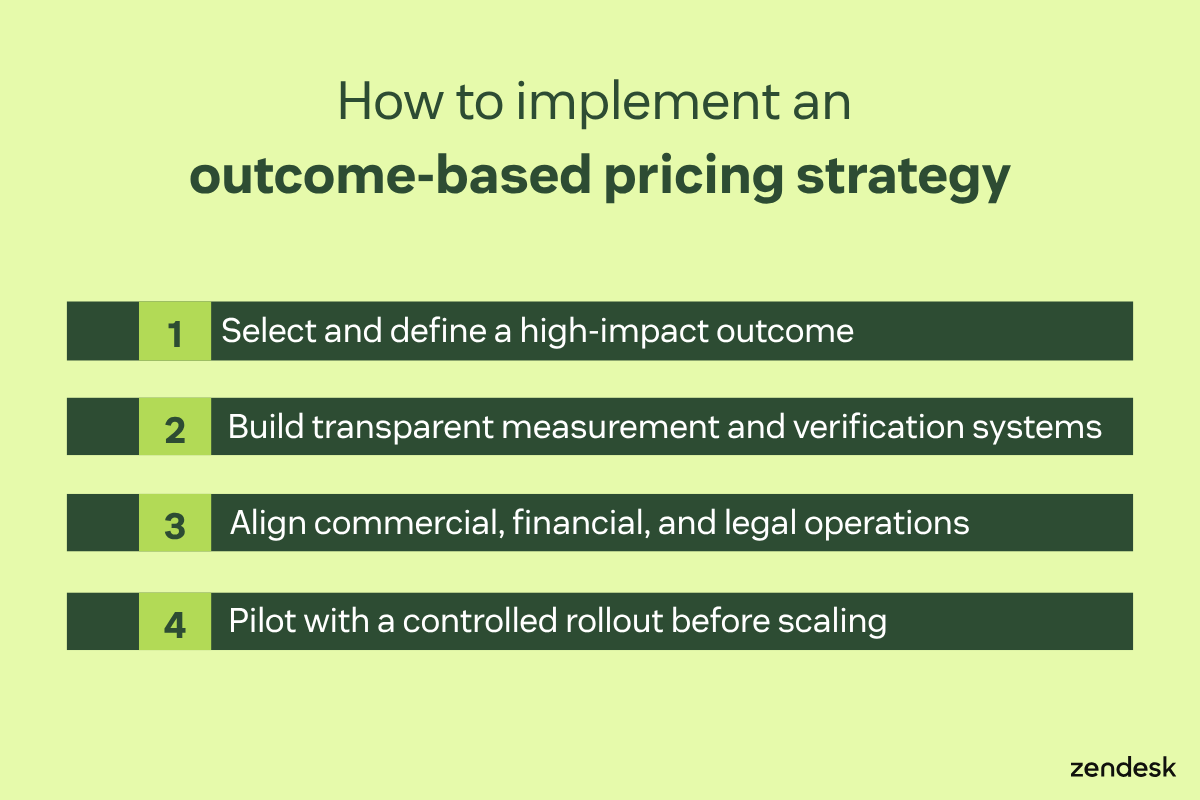
- Select and define a high-impact outcome: Start by choosing a business result that is measurable, attributable, and financially meaningful. The best outcomes are easily understandable for both sides and closely tied to customer value. Once the outcome is chosen, define it precisely. Document how it will be counted, which baselines apply, which conditions qualify, and what is excluded. Clear rules reduce ambiguity and make the model easier to trust.
- Build transparent measurement and verification systems: Outcome-based pricing only works when results can be tracked consistently. This usually requires product logs, APIs, instrumentation, or other systems that capture outcomes as they happen. Customers also need visibility into the data. Shared dashboards, regular reconciliations, and clear validation processes help both sides confirm results and resolve discrepancies before they become billing issues.
- Align commercial, financial, and legal operations: A successful rollout depends on more than measurement. Sales teams need clear messaging, finance teams must update forecasting models, and legal teams should ensure contracts support outcome-based billing. Companies may also put safeguards in place, such as caps, minimums, or hybrid pricing structures, to manage risk.
- Pilot with a controlled rollout before scaling: It’s wiser to test outcome-based pricing before launching it broadly. A pilot with a small customer group can help teams validate the outcome, pricing logic, and reporting process. This early data makes it easier to refine the model. Once the company has confidence in the measurement, contract terms, and operational workflows, it can expand the strategy with less risk. Keep in mind that internal alignment across pricing, product, billing, and revenue operations is essential before scaling the model.
Frequently asked questions
Power outcome-based pricing with Zendesk AI agents
See outcome-based pricing in action with Zendesk AI agents. Priced per automated resolution, you’ll only pay for a customer interaction that’s been successfully handled by an AI agent with no human intervention. With transparent, scalable pricing built into Zendesk Suite and Support plans, you can confidently automate more interactions while staying aligned with measurable results.
