Guides • 5 min read
The road to AI maturity (Part 3): Empower your team with AI assistance
In the third and final part of our AI Maturity series, we look at how insight and human expertise come together to drive better outcomes.


Meaghan Watson
Product Marketing Manager, Best Practices and Adoption at Zendesk
Ultimo aggiornamento December 17, 2025


As we wrap up our AI Maturity series, the focus shifts from foundational work to higher-order execution. You’ve laid the groundwork. You’ve automated routine tasks. Now, AI brings it all together by transforming service data into operational insight that helps teams optimize workflows and run more effectively at scale.
At this stage, AI plays two distinct, but connected roles. First, it provides operational intelligence—surfacing the context leaders and admins need to optimize workflows, allocate resources, and run service more effectively at scale. Second, it delivers real-time assistance to agents, applying that intelligence inside the workspace to guide actions, reduce friction, and enable consistently high-quality customer experiences.
In this final step, the focus shifts to the interactions that truly need a human touch—the complex, nuanced interactions where empathy and expertise matter most, but are hardest to deliver at scale. Here, AI evolves from a helpful tool into a true driver of operational excellence, giving your team the visibility needed to navigate critical moments with confidence and care.
Operational intelligence that helps you scale
AI makes it possible to understand what’s happening across every customer interaction, both automatically and in real time. Rather than relying on manual tagging or limited sampling, AI analyzes each ticket to surface why customers are reaching out, what issues they’re experiencing, and where friction is building.
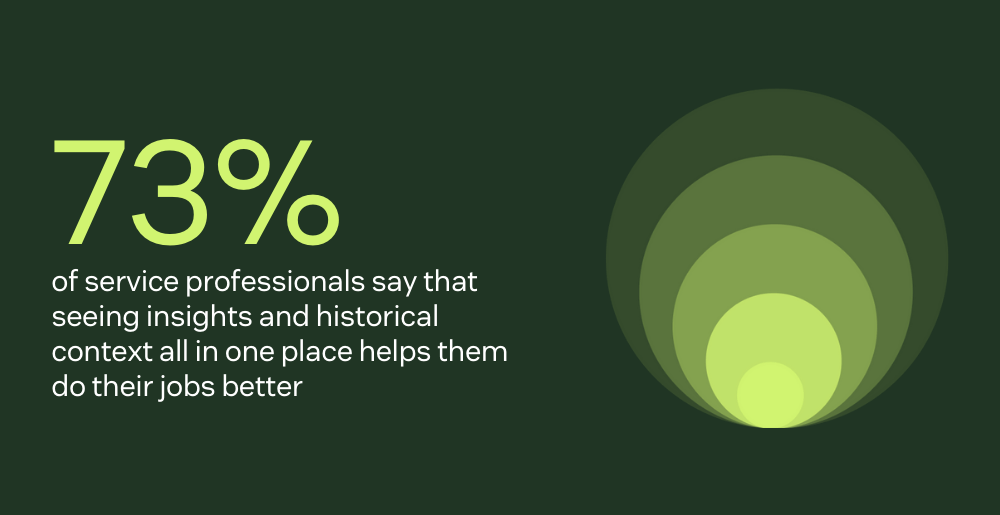
In fact, 73% of service professionals say that seeing insights and historical context all in one place helps them do their jobs better. Instead of piecing together fragmented details across multiple systems, they’re empowered with the context they need to resolve issues faster, reduce customer effort and frustration, and make every interaction smoother and more efficient.
AI-powered ticket classification tools, like intelligent triage, go beyond surface-level data. They read between the lines to uncover deeper insights: the ‘why’ behind the request, the specific issue or product involved, the customer’s emotional tone, and the language they’re using.
By turning unstructured conversations into actionable insight, leaders have a clear view of demand patterns and emerging issues. This helps teams prioritize the right work, rebalance resources during spikes, automate repeatable flows, and design workflows that reflect how customers actually behave. The result? Faster resolutions, better use of agent time, and more predictable service outcomes.
Take Freedom Furniture, for instance. By leveraging AI-powered insights, they slashed manual triage hours by 92% and cut first response times by 74%, freeing their team to focus on more complex customer issues.
Agents empowered with AI assistance
Once AI has created operational clarity, that same intelligence can be applied within the agent workspace.
As discussed earlier in the series, not every ticket should be deflected or fully automated. Many still require an agent’s judgement, empathy, and expertise. For these interactions, AI assistance supports agents in real time, helping them stay focused, calm, and consistent, even during complex or high-pressure conversations.
These AI tools guide next steps and ensure compliance without forcing agents to search across systems or rely on memory alone. Features like auto assist, paired with clearly defined procedures, act like a trusted guide, proactively prompting agents on the right responses and actions in the right moment.
If your procedures aren’t documented yet, don’t worry. They often exist informally. Here are five steps to help you get started:
Identify high-volume tickets with clear, repeatable processes
Evaluate recurring, high confident intents
Analyze agent ticket touches (e.g. how often agents comment or update tickets) to spot repetitive work
Investigate common call drivers to determine where standardized responses could boost efficiency
Practice agent shadowing to understand the real-world workflows and uncover opportunities to add automation or guided assistance
From there, auto assist can be configured to take action on an agent’s behalf—with their approval. Whether these actions occur within your own system or integrate with third-party platforms, routine tasks like processing refunds, updating customer profiles, or adjusting orders can be triggered automatically right within your agents’ workspace. This advanced workflow automation cuts friction, speeds up resolution, and minimizes errors.
The power of AI plus your people
Achieving AI maturity is an ongoing journey, not a “set it and forget it” moment. As customer expectations evolve and new insights emerge, continuous learning and refinement remain essential.
Simply adopting AI technology isn’t enough to drive meaningful change. Adoption depends on transparency, effective change management, and strong feedback looks that help teams see AI as a trusted teammate rather than a replacement. Regular training and celebrating of wins builds confidence and reinforces this collaborative mindset.
AI-driven recommendations give admins and team leads visibility into bottlenecks and hidden opportunities, enabling smarter decisions that improve both operational performance and customer satisfaction. At the same time, integrated workforce management (WFM) and quality assurance (QA) tools provide a comprehensive operational overview, helping leaders proactively manage staffing, maintain high service quality, and smoothly adjust as customer needs shift.
The real magic happens when AI and people work in sync. By combining smart tools with a culture of learning and collaboration, organizations can empower agents, give admins clear direction, and deliver standout experiences—time and time again.
As this AI Maturity series comes to a close, one thing is clear: AI-powered excellence isn’t just about the tools used, but how insight, context, and human expertise come together to drive better outcomes.
Even though the tools will continue to evolve, the goal will remain the same: delivering exceptional experiences that build trust, loyalty, and long-term success. With the strategies shared throughout this series, your organization now has the confidence needed to adapt, innovate, and thrive in a dynamic service landscape.