Article • 8 min read
The ultimate guide to change enablement
Learn how to enable progress and deliver change effectively, without slowing teams down or increasing risk.


Justine Caroll
Director, Product Marketing
Last updated February 11, 2026


As the pace of work accelerates, driven by new tools and workflows, many IT teams are finding that traditional change management approaches are slowing them down. Processes designed to reduce risk and maintain stability instead introduce friction. In practice, this looks like:
One-size-fits-all governance through a change advisory board (CAB).
Rigid change windows.
Legacy, siloed systems built on manual ticket fields and sequential handoffs.
This results in long wait times, limited visibility into outcomes, and teams left wondering if all that effort delivered any tangible value.
Change enablement offers a better path forward. More than a buzzword, it represents a shift away from linear, top-down change management. Instead of focusing on approvals, it focuses on outcomes, helping IT teams deliver more changes with less friction, while improving overall employee experience (EX) and ROI.
In this guide, you’ll learn what change enablement means for your organization, and why it matters now. We’ll cover how you can adopt a modern value-driven approach to change that supports agility, protects productivity, and scales as your organization grows.
More in this guide:
- What is change enablement?
- Why is change enablement so important?
- Change enablement vs. change management
- Change enablement process: A step-by-step framework
- Key components of successful change enablement
- Best practices for implementing change enablement
- Discover how Zendesk’s employee service solution enables change at scale
What is change enablement?
Change enablement is the practice of making changes to services, systems, and processes in a way that’s valuable, fast, and safe. It shifts the mindset around change from control and prevent to enable and improve. It’s about managing risk in a way that removes unnecessary bureaucracy and supports teams that need to move quickly. Change enablement keeps the guardrails, but removes the barriers.
Why is change enablement so important?
Every poorly managed change creates downtime, confusion, extra support tickets, and forced workarounds. All of these reduce employee productivity and satisfaction.
When you effectively enable change, the quality of your employee service soars. Employees are prepared for change rollouts through coordinated planning, support, and communication. This empowers employees to adapt to new tools like AI agents or employee self-service portals quickly. As a result, employees get back to productive work faster, improving their experience while accelerating your business’s time to value.
This elevation in productivity is where the positive financial impact of change enablement comes into place. By reducing manual workload, optimizing processes, and minimizing rework, businesses drive ROI while streamlining workflows. In short, adopting change enablement transforms change into an ROI driver, not a process tax.
In a rapidly evolving technology landscape, the ability to adapt quickly has become a competitive advantage. Change enablement helps your organization move fast without introducing unnecessary risk. It reframes the classic “move fast and break things” startup mindset into something more sustainable: move fast because you’ve put the right structures in place.
Change enablement vs. change management
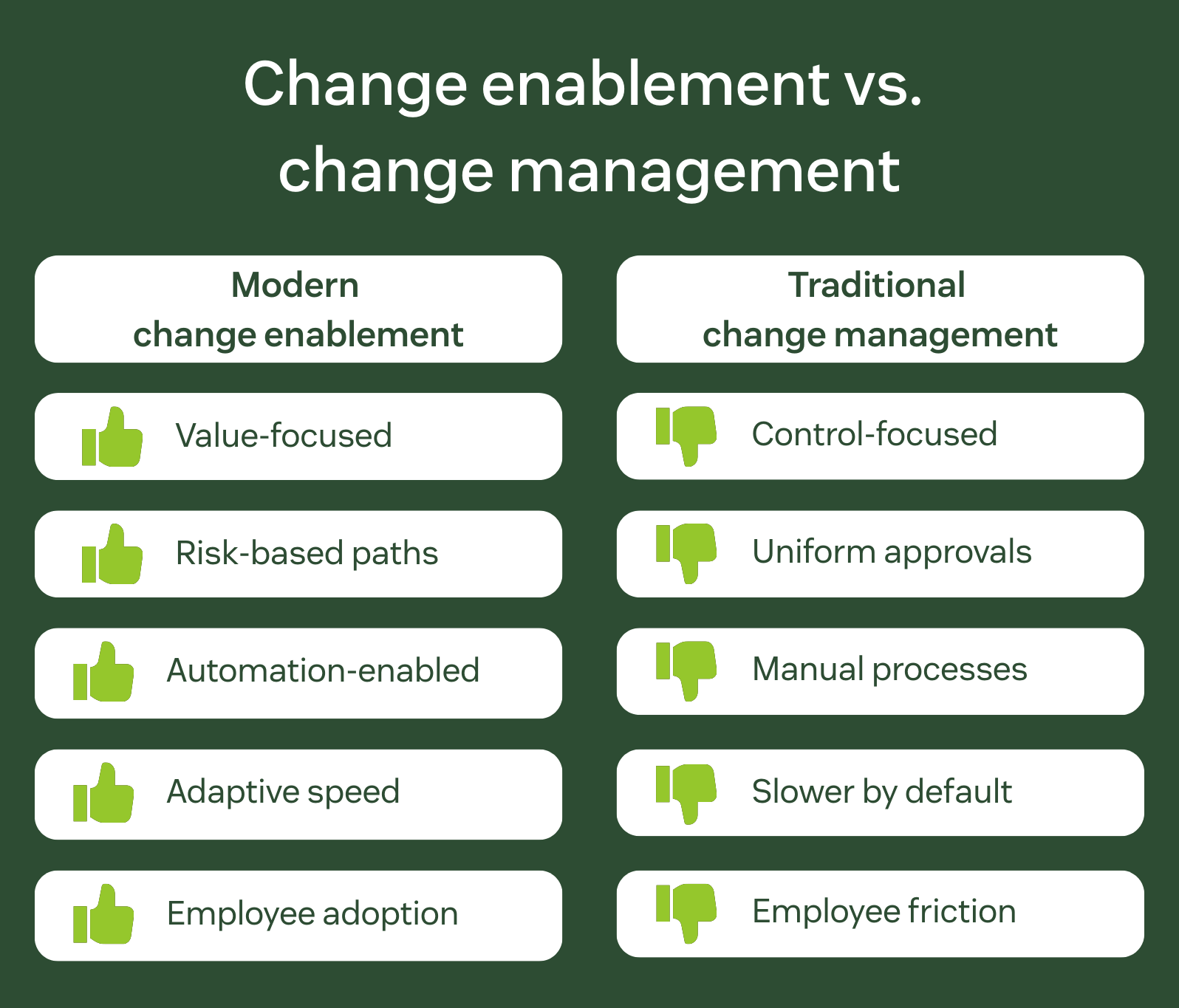
The terms change management and change enablement are often used interchangeably, particularly in IT service management (ITSM) conversations.
While traditional change management models provide structure for managing change, change enablement represents a modern evolution of these practices—reflected in ITIL 4 frameworks. The key differences come down to mindset, approach, and outcomes.
Area | Change management | Change enablement |
Core mindset | Control and prevent risk | Enable value while managing risk |
Primary goal | Reduce incidents and outages | Deliver change safely and effectively |
Governance model | One-size-fits-all approach | Risk-based pathways |
Speed of change | Slower by default | Faster where risk is low |
Role of automation | Limited, manual | Built in to reduce friction |
Employee impact | Change is endured by employees | Change is adopted quickly by employees |
ITIL alignment | Legacy ITIL versions | Current ITIL 4 practice |
Change enablement process: A step-by-step framework
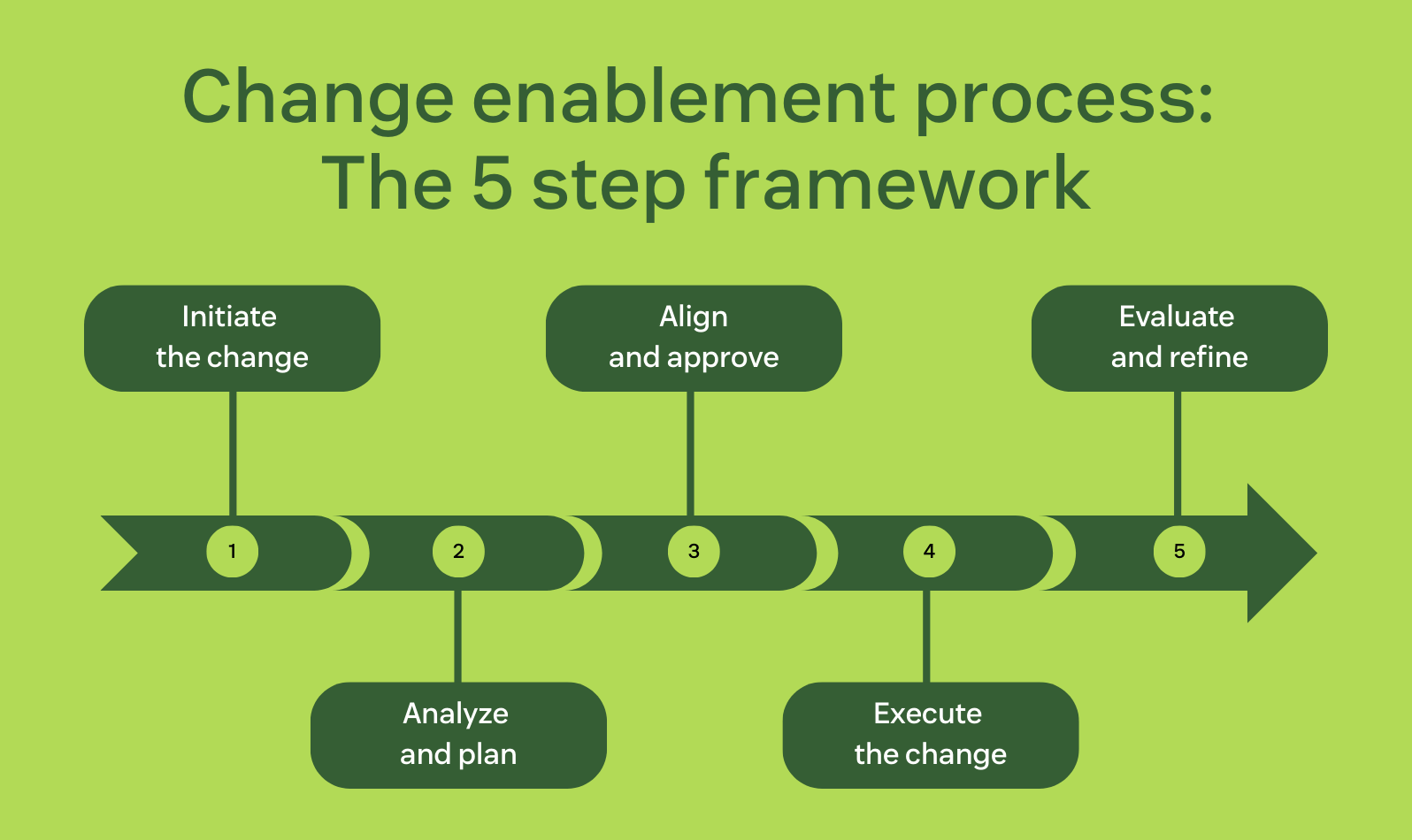
The process of implementing change enablement isn’t one-size-fits-all. How you approach it will vary based on your organization, industry, and operating model.
That said, effective change enablement follows a consistent workflow that can be supported and automated using ITSM tools. It all starts with initiating the change.
1. Initiating the change
The first step in change enablement is to ask:
Why is the change happening?
What outcome will it achieve?
Who’s requesting the change and who will it impact?
The key goal of this step is to capture the intent behind the change, not just the request itself. Common drivers might include reducing friction, improving reliability, or supporting new ways of working.
By establishing clear intent upfront, you create a shared understanding of the driving force behind the change. This allows you to assess risk more quickly, align sooner, and reduce the chance of misinterpretation later on.
2. Strategic analysis and planning
The next step is to understand the potential impact of the change, before taking action. Not all changes carry the same level of risk, and analysis should be proportional, not exhaustive. The goal is to make informed decisions without slowing down change unnecessarily.
Start by considering the scope of the change, its dependencies, and the services or teams affected. Then, apply a risk-based approach:
Lower-risk changes can move through approval and execution more quickly.
Higher-risk changes receive deeper analysis.
This helps teams focus time and attention where it matters most. The result is fewer avoidable incidents and last-minute surprises, plus clearer communication for employees.
3. Approval and alignment
This step is all about balancing accountability and momentum. Approvals exist to protect the business, not create bottlenecks. Approval paths should reflect risk, follow a consistent and transparent flow, and avoid unnecessary handoffs. Decision-making should have clear ownership, while staying aligned across teams such as IT, HR, security, and ops to reduce friction further down the line.
This will enable you to make changes quickly not because your process has fewer steps, but because there is clarity across the approval path.
4. Execution
The execution stage of change enablement is where your employees actually experience change. The goal is to make that experience as smooth and predictable as possible to minimize disruption. To do this effectively, establish clear timelines, coordinate the rollout, and communicate proactively with your employees.
They should understand:
What’s changing
When it’s happening
Where to get help if they need it
Good execution minimizes downtime, reduces ticket spikes, and protects productivity. Just as importantly, it also helps employees feel supported throughout the change, improving employee satisfaction and overall employee experience.
5. Evaluation and refinement
Change enablement improves through continuous feedback. After each change, it’s important to review whether the impact matched expectations for both service performance and employee experience. One of the most effective ways to do this is to speak with your employees directly.
Once you’ve collected and reviewed the feedback, you can use it to refine future changes, adjust guardrails, and further improve employee experience.
Key components of successful change enablement
While process plays an important role in a modern change enablement strategy, it’s not enough on its own. Successful change enablement also relies on the right combination of automation, insight, and collaboration.
AI and automation
By reducing manual effort and friction, AI and automation help teams move faster without sacrificing consistency or safety. This starts with automation to remove repetitive work, manual handoffs, and inconsistent execution by standardizing low-risk, repeatable changes.
AI can also help support change by identifying potential risk, routing changes efficiently, and flagging anomalies or dependencies. This empowers support teams to make faster decisions, prioritize effectively, and focus on higher-impact work. This results in a more efficient employee service, a better employee experience (EX), and enhanced productivity.
Data-driven decision making
Data-driven decision making moves your change enablement strategy from intuition-led decisions to insight-driven improvement. Data helps teams understand what’s working, identify patterns and potential risk, and improve over time. Evidence-based decisions are more consistent, easier to justify and less subjective. This builds trust in the change enablement process and increases confidence across stakeholders, including IT, leadership, and finance.
Culture of collaboration
Change rarely affects only one team, so it shouldn’t be owned in isolation. Collaboration and alignment across IT, HR, security, and operations help teams:
Anticipate employee impact
Coordinate communication
Reduce downstream friction
Together, this ensures change is supported end-to-end, improving employee experience while minimizing risk during rollout and adoption.
Best practices for implementing change enablement
Change enablement doesn’t ignore change management principles; it applies them in a modern, scalable way that helps teams move faster without adding complexity.
These best practices can help you put change enablement into action while keeping costs down and time to value high.
Start small and scale
You shouldn’t redesign all your change processes all at once. Instead, look at where volume is high, risk is low, and impact is visible. Introducing change enablement here helps teams see value quickly, building confidence in the process, creating momentum, and securing early wins. Incremental progress also surfaces lessons you can apply as you scale change enablement organization-wide.
This approach has the added benefit of a lower upfront cost to the company, and causing less disruption if something doesn’t work as expected.
Prioritize communication
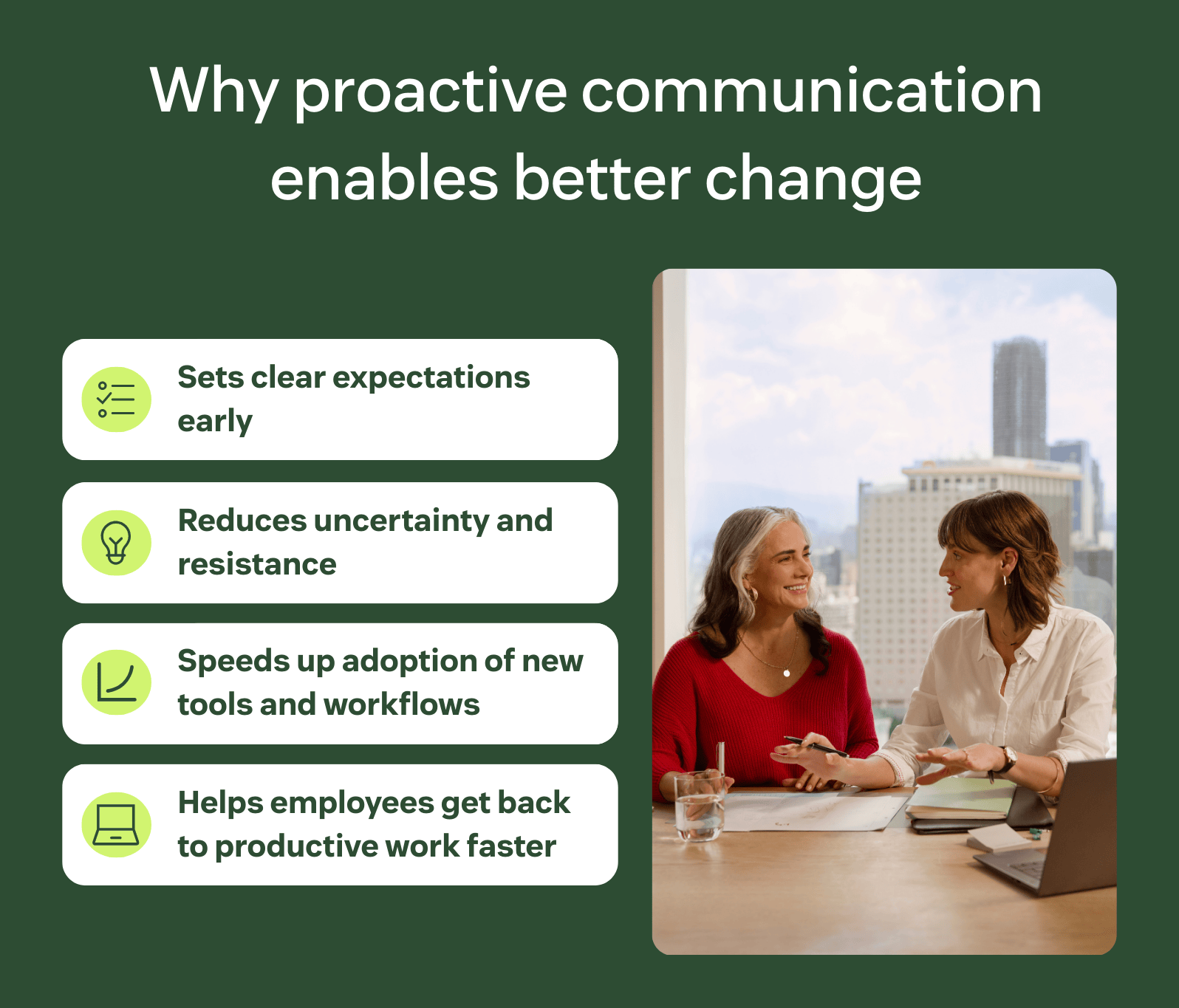
Managing expectations before problems appear is one of the best ways to avoid resistance when it comes to change. When communication is clear, transparent, and timely, employees experience less uncertainty, feel more included, and adopt new changes faster.
By building proactive communication into the change process, teams reduce confusion and shorten the time it takes for employees to get back to productive work. In other words, communication isn’t an afterthought—it’s a key driver of faster time to value.
Leverage the right tools
When implementing change enablement, it’s essential to avoid tool bloat, which can introduce unnecessary complexity and harm adoption.
The right tools should reduce effort and friction, not add new steps. This is why an integrated platform matters. It helps teams standardize workflows, automate routine work, and keep information in one centralized repository. This will increase time to value while keeping the change experience simple for employees.
Discover how Zendesk’s employee service solution enables change at scale
Moving from rigid change management to agile change enablement is more than a process shift; it’s a mindset shift. It helps IT teams deliver change faster, with less risk, while keeping the employee experience positive. It also protects productivity and makes it easier to scale and adapt as the organization evolves.
Employee service platforms play a vital role in making this shift possible. They help IT teams enable change consistently by standardizing workflows, supporting clear communication, and reducing manual effort without adding complexity.
If you’d like to learn more, Zendesk’s employee service solution is built to support this kind of change enablement at scale. It helps teams deliver efficient service while keeping the employee experience front and center.